Why this wildfire season matters for the people you love
California is in active wildfire season, and smoke advisories are affecting air quality in multiple parts of the state, tracked in real time by the California Air Resources Board and the EPA's AirNow.gov. Southern California does not have to be near an active fire to feel it. Smoke drifts, and Chino Hills, the Inland Empire, Orange County, and Los Angeles routinely see their air quality affected by fires burning elsewhere in the state or region.
For a healthy adult, a smoky week usually means watery eyes, a scratchy throat, and closed windows. For a parent with COPD, congestive heart failure, or a history of a cardiac event, and for many elderly homebound adults, wildfire smoke is a genuine clinical risk, not a discomfort to wait out. The distinction matters because the two situations call for different responses, and a family checking in by phone once a day usually cannot tell which one they are actually in.
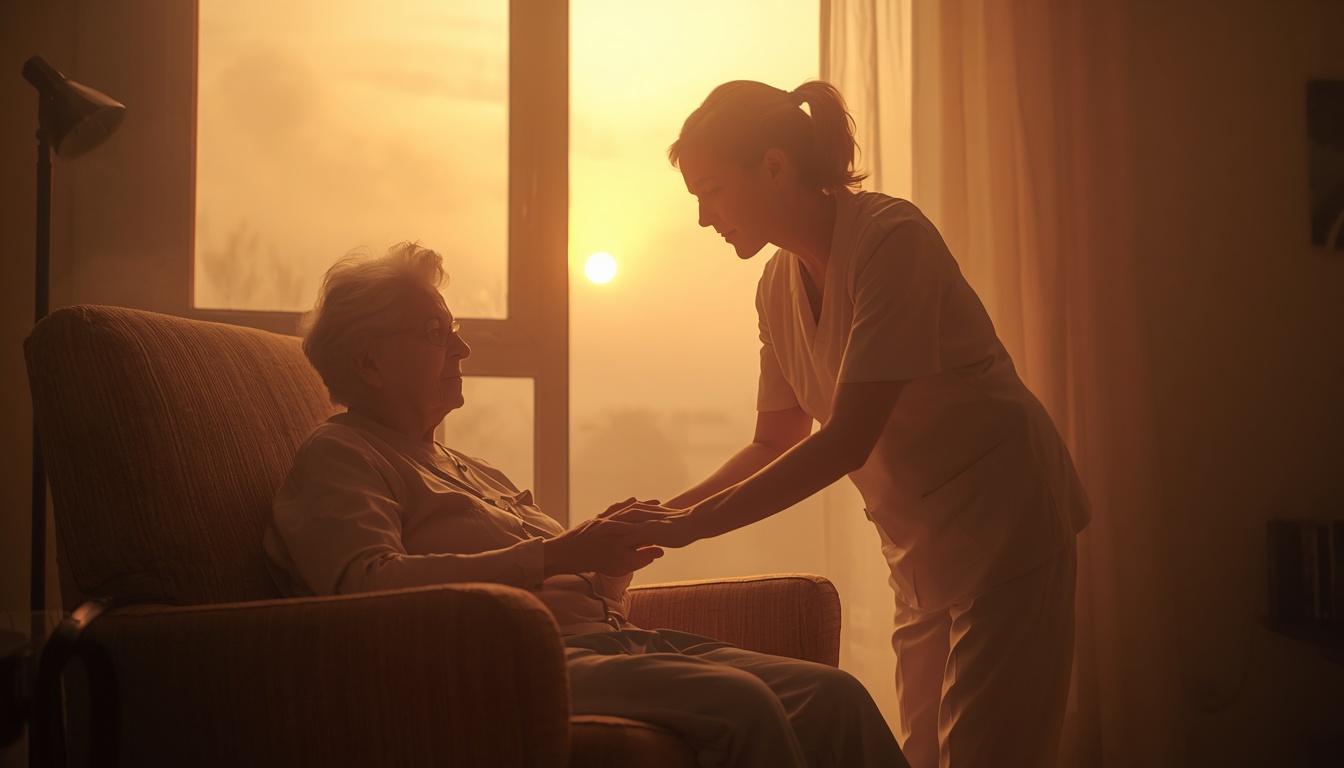
That is the practical problem this page is written to address. A phone call cannot hear a new wheeze, cannot watch how hard someone is working to breathe walking from the bedroom to the kitchen, and cannot check whether the air conditioning is actually set to keep smoke out or is quietly pulling it in. A concierge RN physically in the home can do all three, and knowing what to watch for is the first step whether or not a nurse is involved yet.
How wildfire smoke actually harms the body
Wildfire smoke is not simply an unpleasant odor to tolerate until the wind shifts. Its main hazard is fine particulate matter, referred to as PM2.5, meaning particles 2.5 micrometers in diameter or smaller. The U.S. Environmental Protection Agency states that PM2.5 is roughly 30 times smaller than the diameter of a single human hair.
That size is exactly what makes it dangerous. The body's upper airway is built to filter out larger particles, dust, pollen, and typical debris, but particles this small largely bypass those defenses. The EPA states that some of these particles can travel deep into the lungs, and some may even enter the bloodstream.
The California Air Resources Board and AirNow.gov describe the resulting health effects as a real range, not a single symptom: from mild eye and respiratory irritation on the low end, up to serious worsening of existing heart and lung disease, including asthma, and in severe cases, premature death in vulnerable populations. Most people who smell smoke and feel fine are experiencing the mild end of that range. The people this page is written for are the ones for whom smoke exposure can land further up it.
Who is most at risk, and why "healthy" does not automatically mean "safe"
The California Air Resources Board and AirNow.gov identify the groups who should be especially vigilant during a smoke event: children, seniors, pregnant people, people with asthma or other respiratory conditions, and people with heart conditions. For WholeHealth Concierge's clients, that list usually means someone managing COPD, congestive heart failure, recovery from a cardiac event, or the general frailty that comes with reduced physical reserve.
The point families most often miss is the "seniors" category itself, regardless of a specific diagnosis on a chart. Research on the aging lung from the National Institutes of Health describes measurable, normal changes that come with age: decreased lung elasticity, reduced lung volumes, and weaker cough strength, all of which reduce the respiratory reserve available when smoke or another irritant is added to the mix. A parent who has never been diagnosed with a lung or heart condition can still have meaningfully less capacity to tolerate a heavy smoke day than a healthy adult in their thirties.
In practice, that means "Mom doesn't have COPD, so she should be fine" is not a safe assumption during a smoke advisory. Age itself is a risk factor CARB and AirNow guidance calls out directly, separate from any diagnosis. If a parent is elderly and largely homebound, they belong on the watch-closely list even if their chart looks clean.
What to actually do at home during a smoke event
Start with the air the home is actually circulating. For a house with central ducted heating or air conditioning, set the system fan to run continuously rather than only cycling on and off with heating or cooling, so air keeps moving through the filter. Close the fresh-air intake so the system recirculates the air already inside instead of pulling in smoky air from outside. Both steps come directly from California Air Resources Board and AirNow guidance, and neither one is the default setting on most thermostats, so it is worth checking rather than assuming it is already configured correctly.
If someone in the home has to be outside for an extended period during heavy smoke, reach for a NIOSH-certified N95 respirator, not a cloth mask or a surgical mask. CARB and AirNow are specific on this point: cloth and surgical masks do not filter the fine particulate matter that makes wildfire smoke dangerous, so they do not provide meaningful protection against it, even though they help with other things.
Air quality during a smoke event changes hour to hour, sometimes block to block, which is why we are not going to print a number on this page and ask you to trust it. For real-time, location-specific conditions, the EPA's Fire and Smoke Map at fire.airnow.gov is the tool we point our own clients' families to. It is free, it updates continuously, and it lets you check your parent's exact city before deciding whether today is a stay-inside day.
What a concierge RN actually does during a smoke event
Being in the home in person changes what is actually observable. A concierge RN assesses respiratory status directly: listening to how someone sounds getting up from a chair, watching the effort and rate of breathing rather than relying on a self-report of "I'm fine," and, for clients whose care plan already includes a pulse oximeter, following the trend in oxygen saturation over the visit rather than treating one reading as the whole picture.
The nurse also verifies the home environment instead of assuming it. That means physically checking that the HVAC fan is set to run continuously and the fresh-air intake is closed, not asking a family member whether it is and taking the answer on faith. Homes get this wrong constantly, not from neglect, but because the settings are unfamiliar and nobody checks them outside of a smoke event.
For clients managing COPD or congestive heart failure specifically, the nurse is watching for the early signs that a chronic condition may be starting to decompensate under the added burden of smoke exposure: increased coughing, new or worsening shortness of breath, breathing that takes more visible effort, or fatigue beyond what is typical for that person. Catching those signs early is the whole point. It is the difference between a phone call to the treating physician on a Tuesday afternoon and a trip to the emergency room on a Friday night.
If symptoms are escalating, the nurse's job is to coordinate with the patient's physician directly, relay what has actually been observed and how it has changed, and help the family decide what level of care the situation now calls for, rather than leaving that judgment call to a worried family member alone.
Sources checked 14 August 2026. Wildfire smoke health effects, sensitive groups, N95 respirator guidance, and HVAC recirculation guidance from the California Air Resources Board (ww2.arb.ca.gov) and AirNow.gov, a joint EPA, NOAA, CDC, and National Park Service site. PM2.5 particle size and lung and bloodstream penetration per the U.S. Environmental Protection Agency. Real-time local air quality is tracked at the EPA's Fire and Smoke Map, fire.airnow.gov, rather than reproduced here, because conditions change hour to hour. Aging lung function and reduced respiratory reserve per National Institutes of Health research on the aging lung. This page is general education about wildfire smoke, not medical advice about any individual, and it is not a substitute for emergency medical care. If you or someone in your care has severe shortness of breath or chest pain, seek immediate medical attention.
Concierge nursing support across the Inland Empire, Orange County, and LA
WholeHealth Concierge is based in Chino Hills, at the meeting point of San Bernardino County, Riverside County, Orange County, and Los Angeles County. During a smoke event, that means we can be in your parent's home checking on them directly, not just talking through it by phone.
Chino Hills · Rancho Cucamonga · Ontario
Home-base coverage across the western and central San Bernardino Valley, our fastest response area.
Corona · Eastvale · Temecula
Inland Empire coverage for families closest to our Chino Hills base.
Irvine · Newport Beach · Lake Forest
Respiratory monitoring and complex care support across coastal and central OC.
Pasadena · San Gabriel Valley
RN-led private nursing and care management across the LA metro.
Wherever your family lands during a smoke event, our private duty nursing and care management programs put a vetted, insured RN in the home, watching for the things a phone call cannot catch.
If smoke is in the forecast, let's make sure the plan is too.
A short call covers what to watch for in your specific situation, whether the home is actually set up right, and whether in-home nursing support during smoke season makes sense for your family. No pressure, and no obligation either way.
Wildfire smoke and home safety, answered.
Does wildfire smoke from a fire far away still affect air quality at home?
Yes. Smoke can travel hundreds of miles from the fire that produced it, which is why Chino Hills, the Inland Empire, Orange County, and Los Angeles can see poor air quality from fires burning elsewhere in the state or region, not just from fires nearby. Real-time local conditions are tracked at the EPA's Fire and Smoke Map, fire.airnow.gov.
Is wildfire smoke dangerous for a senior with no diagnosed heart or lung condition?
It can matter more than families assume. Lungs naturally lose some capacity with age, so an older adult without a formal diagnosis can still have less reserve to tolerate a smoke event than a younger, healthy adult. The California Air Resources Board and AirNow.gov list children, seniors, pregnant people, and people with asthma, other respiratory conditions, or heart conditions as groups who should be especially vigilant.
What does wildfire smoke actually do to the body?
Wildfire smoke's main hazard is fine particulate matter, called PM2.5, which the EPA states is roughly 30 times smaller than the diameter of a human hair. Because the particles are so small, some can travel deep into the lungs, and some may even enter the bloodstream. Health effects range from mild eye and respiratory irritation to serious worsening of existing heart and lung disease, including asthma, and in severe cases, premature death in vulnerable populations.
Should a cloth or surgical mask be enough protection during a smoke event?
No. A cloth or surgical mask does not filter fine particulate matter. For anyone who has to be outdoors for an extended period in heavy smoke, a NIOSH-certified N95 respirator is the protection recommended by air quality authorities.
How should we set the air conditioning or heating system during a smoke event?
If the home has central ducted heating or air conditioning, set the system fan to run continuously rather than only cycling with heating or cooling, so air keeps moving through the filter, and close the fresh-air intake so the system recirculates indoor air instead of pulling in smoky outdoor air.
Where can I check the current air quality for my parent's specific city?
The EPA's Fire and Smoke Map at fire.airnow.gov gives real-time, location-specific air quality information. Air quality changes hour to hour during a smoke event, so a live source like this is more useful than any single number printed on a webpage.
What are early signs that smoke may be affecting someone with COPD or heart failure?
Watch for increased coughing, new or worsening shortness of breath, more fatigue than usual, or breathing that feels harder with normal activity. These can be early signs that smoke exposure is affecting a chronic heart or lung condition, and they are worth reporting to the treating physician promptly rather than waiting to see if they pass.
What does a concierge RN do during a smoke event that a phone call cannot?
A nurse physically in the home can assess respiratory status in person, follow oxygen saturation trends for clients whose care plan already includes pulse oximetry, verify that the home's HVAC system is actually set to recirculate rather than assuming a family member set it correctly, and recognize early signs of an exacerbation in a COPD or CHF patient early enough to coordinate with the treating physician before it becomes an emergency.
When does this stop being a home-monitoring situation and become an emergency?
This page is general education, not a substitute for emergency medical care. Severe shortness of breath, chest pain, or blue-tinged lips or fingertips are reasons to seek immediate medical attention rather than wait for a home visit or a callback.