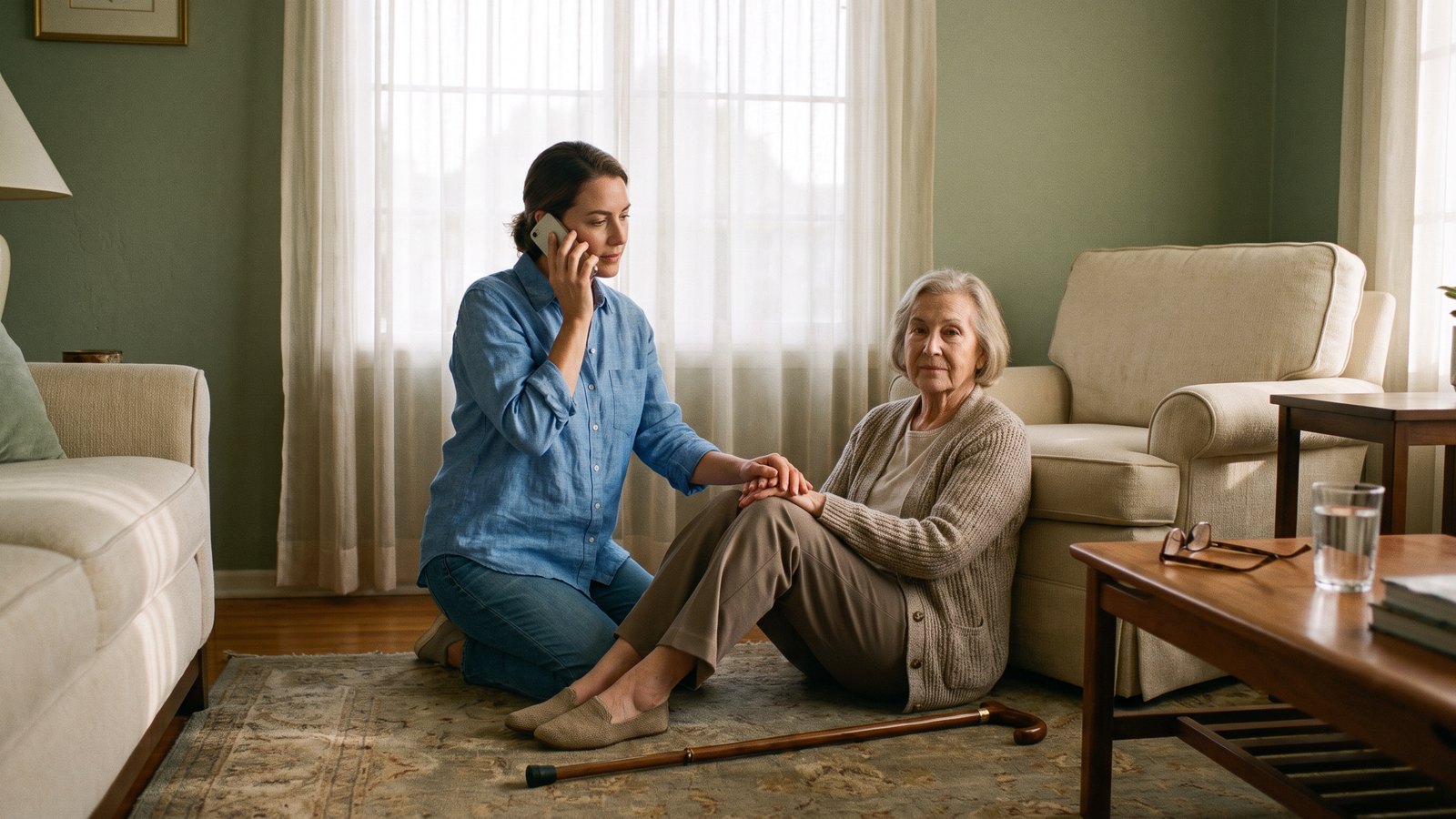
- Do not lift them yet. Check that they can move each limb without pain, and look at whether either leg appears shorter or turned outward, before anyone touches them.
- Call 911 for any loss of consciousness, confusion, a head strike in someone on a blood thinner, an inability to bear weight, a deformed limb, or a fall that followed a blackout rather than a trip.
- A normal x-ray does not rule out a fracture. In one review of 2,992 patients, 39 percent of suspected hip fractures with a clear x-ray were found on MRI.
- How long they were on the floor matters. An hour or more is treated as its own medical event, separate from the fall.
- Before discharge, ask whether they were admitted or are under observation. Observation time does not count toward Medicare's three-day requirement for covered rehab, and families have paid thousands over this.
- A fall with no injury is still a warning. Falling once doubles the chance of falling again.
The first sixty seconds
The instinct is to get them up off the floor. Resist it. A person who has just fallen cannot always tell you what hurts, and lifting someone with a fractured hip or an injured spine can turn a bad injury into a much worse one. Before anything else, kneel down where they can see you and work through four things.
Are they awake and talking normally?
Not just awake. Talking the way they normally talk. Slurred speech, confusion, or an answer that does not match the question is a different situation than a sore hip, and it changes what you do next.
Did their head hit anything?
Ask, and then look. Older skin bruises late, so the absence of a mark on the scalp in the first minute means very little. If they cannot remember the fall itself, treat that as a head strike.
Ask them to move each limb before you move them
Have them wiggle their fingers and toes, then slowly bend each knee. Watch their face rather than listening to their words, because a lot of parents will say they are fine while wincing. If one leg looks shorter than the other or the foot is turned outward, stop and call 911. Per the NHS, those are classic signs of a broken hip alongside severe pain in the hip or groin and an inability to bear weight.
Only then, help them up slowly, and only if nothing hurts
The safe sequence is to roll onto their side, then onto hands and knees, crawl to a sturdy chair, place the stronger foot forward, and rise slowly using the chair rather than your arms. If anything hurts along the way, stop and leave them where they are with a pillow and blanket while you call for help. Trying to haul an adult off the floor is how the second injury happens, to them or to your back.
Call 911 now if any of these are true
This is not a judgment call to sit with. The National Library of Medicine's guidance on head injury is specific, and these signs mean an ambulance rather than a car ride.
- They lost consciousness, even briefly, or cannot remember falling
- They are unusually sleepy, confused, or their speech does not make sense
- A severe headache, a stiff neck, or repeated vomiting
- A seizure
- Pupils that are unequal in size
- They cannot move part of an arm or leg
- They cannot bear weight, or a limb is visibly deformed, or one leg looks shorter or rotated outward
- Chest pain, shortness of breath, or the fall followed a blackout rather than a trip
That last one matters more than most families realize. A trip over a rug and a faint that ended on the floor look identical afterward, but they are different problems. Emergency clinicians are trained to separate a mechanical fall from a fainting episode precisely because a cardiac cause changes everything about what happens next. If nobody saw it happen and your parent cannot say whether they tripped or blacked out, say exactly that to the dispatcher.
If they take a blood thinner, the rules change
Anyone on an anticoagulant or antiplatelet medication who has hit their head needs to be evaluated, even when they feel fine and look fine. Clinical guidance for emergency departments is that older patients with a head injury who are anticoagulated generally require a CT scan of the head, and UK national guidance sets a window of within eight hours.
The reason is that bleeding inside the skull can develop slowly and quietly. A study of 218 anticoagulated patients aged 65 and over who had a minor fall and a normal first CT found delayed bleeding in one of them. That is a small number, and it is not a reason to panic, but it is the reason a normal scan does not end the story. Watch for a headache that keeps getting worse, new drowsiness, vomiting, weakness on one side, or a personality change over the following days, and go back if any of it appears.
Bring the medication list with you. Not a description of it, the actual bottles or a photo of them. It is the single most useful thing a family member can carry into an emergency department.
If they seem completely fine
This is the situation that catches families out, because there is no obvious decision to make and everyone wants to get back to normal.
Two things are worth knowing. The first is that x-rays miss fractures in older bone at a rate most people would find surprising. In a review of 35 studies covering 2,992 patients with an average age of 77, 39 percent of those who had a suspected hip fracture and a normal x-ray were found to have a fracture on MRI. A separate emergency department study of 2,839 older adults after low-energy falls found plain x-ray sensitivity of about 50 percent overall. So if your parent still cannot put weight on that leg two days later, a normal x-ray is not the end of it. Ask about further imaging.
The second is that a fall with no injury is still a warning. The CDC's own framing is that falling once doubles the chance of falling again. A fall that hurt nothing is information: something changed. Blood pressure, a new medication, vision, strength, the rug in the hallway. Something is different, and it will still be different next week.
How long they were on the floor matters more than the fall
Clinicians have a name for it. A long lie means an hour or more on the ground, and it is treated as its own medical event separate from whatever caused the fall, because of what happens to a body lying still on a hard surface: dehydration, pressure injury, low body temperature, kidney injury, and muscle breakdown. Fall and immobilization are the most common causes of rhabdomyolysis in older adults.
A study that followed people aged 90 and over found that 80 percent of those who fell were unable to get themselves up at least once, and 30 percent had lain on the floor for an hour or more. In 80 percent of falls that happened while the person was alone, they did not use their call alarm even when they had one. The long lie was strongly associated with serious injury, hospital admission, and a subsequent move into long-term care.
So when you call the doctor or arrive at the emergency department, lead with how long they were down. It is the detail families most often leave out and clinicians most want to hear.
If this happened in Orange County
Two local things are worth knowing before you pick up the phone, and neither is easy to find anywhere else. One is that calling 911 for a lift assist is not free in every city here. The other is that which emergency room you choose genuinely matters, and Orange County splits unusually cleanly between the two kinds.
Calling 911 when nobody needs the hospital
If your parent is not hurt but you cannot get them up safely, calling the fire department is the right move and crews do it routinely. What surprises families is that in some Orange County cities it is not free even when nobody is transported. Huntington Beach publishes a fee schedule with a line for treatment without transport, billed as an assessment at the scene. Newport Beach states that non-members can be billed for the full cost of paramedic assistance and transportation, and sells a Fire Medics subscription. Anaheim runs a similar membership. Orange County Fire Authority, which covers most of the county, states it does not charge for an emergency call, while noting that Buena Park, San Clemente and Westminster charge paramedic fees and that ambulance transport is billed separately by a private company. Policies change, so it is worth one call to your own city's fire department to ask what a lift assist costs before you need one.
Since January 2024, California law has protected patients from surprise balance billing for ground ambulance transport. If you have a state-regulated commercial plan you pay only your in-network share, and if you are uninsured you cannot be charged more than the Medi-Cal or Medicare rate. The protection does not extend to self-funded employer plans, which cover several million Californians, so it is worth knowing which kind you have.
Which emergency room, if you have a choice
Where you go depends on what happened, and Orange County is unusual in how clearly the two categories separate.
For a serious injury, UC Irvine Medical Center in Orange is the only Level I trauma center in the county. Providence Mission Hospital in Mission Viejo and Orange County Global Medical Center in Santa Ana are Level II trauma centers, per the California EMS Authority's designated trauma center list.
For an older adult who is frail, confused, or has fallen without an obvious major injury, a different accreditation matters more. The American College of Emergency Physicians accredits geriatric emergency departments, which are set up specifically for older patients, with attention to delirium screening, medication review, mobility and discharge planning rather than just the injury in front of them. Eleven Orange County hospitals currently hold that accreditation, including Hoag in Newport Beach and Irvine, St. Joseph Hospital in Orange, MemorialCare Saddleback in Laguna Hills, Huntington Beach Hospital, Garden Grove Hospital, La Palma Intercommunity, West Anaheim Medical Center, and Kaiser Permanente's Anaheim hospital.
UC Irvine Medical Center is the only hospital in the county that is both: the Level I trauma center and the top tier of geriatric emergency accreditation. If your parent has a serious injury, that is a meaningful thing to know. If the fall was minor but something about them seems off, a geriatric-accredited emergency department is likely to catch more than a general one will.
Orange County context: roughly 550,000 residents here are 65 or older, about 17 percent of the county, and close to 100,000 older adults live alone. When Orange County surveyed older residents for its 2025 needs assessment, transportation and in-home care came back as the two services rated most important. Statewide in 2023, falls among Californians 65 and older caused 2,521 deaths, 114,427 hospitalizations and 317,582 emergency department visits.
The question to ask before they are discharged
If your parent ends up in the hospital, there is one question that decides whether the next stage of their care is covered or costs thousands of dollars, and almost no family knows to ask it.
Ask: has she been admitted as an inpatient, or is she under observation?
Under Original Medicare, coverage of a skilled nursing facility stay requires a qualifying inpatient hospital stay of at least three consecutive days. Medicare states plainly that time spent under observation or in the emergency department does not count toward those three days, even if your parent was in a hospital bed overnight. A patient can spend several days in the building, in a gown, in a bed, receiving care, and still be an outpatient for coverage purposes.
Hospitals are required to hand you a Medicare Outpatient Observation Notice when observation runs past 24 hours, and it must be delivered no later than 36 hours in. It is a notice, not an appeal right. The Medicare Rights Center has documented cases of exactly this, including a woman whose mother fell, spent five days under observation without ever being admitted, and paid close to three thousand dollars out of pocket for the rehab stay that followed.
Ask the question early, ask it again before discharge, and ask it of the case manager rather than the nurse at the bedside, who often does not know the billing status. If you are told observation, ask directly whether the physician will consider changing the status to inpatient and why or why not.
Also worth asking before you leave: what imaging was done, and was a CT or MRI ordered if hip pain persists with a normal x-ray. Whether a head CT was done if your parent takes a blood thinner. Whether blood pressure was checked both lying down and standing. Whether anyone did a fall risk assessment or made a physical therapy referral. And who is reviewing the medication list, because that is where the next fall is usually hiding.
The medications most likely to be behind it
The American Geriatrics Society publishes the Beers Criteria, the reference clinicians use for medications that are risky in older adults. Its 2023 edition names a specific list to avoid or reassess in anyone with a history of falls or fractures, because they cause unsteadiness, impaired coordination, fainting, or additional falls.
- Benzodiazepines, and the guidance is explicit that shorter-acting ones are not safer
- The sleep medications zolpidem, eszopiclone and zaleplon
- Opioids
- Antipsychotics
- Antidepressants, including SSRIs, SNRIs and tricyclics
- Antiepileptics
- Anticholinergics, including over-the-counter antihistamines such as diphenhydramine
- Muscle relaxants such as cyclobenzaprine
The criteria also advise avoiding the concurrent use of three or more medications that act on the central nervous system, a recommendation carrying their strongest evidence rating. None of this means stopping anything on your own. It means the list is worth a real review with the prescriber or a pharmacist, and that a fall is the right moment to ask for one.
What actually helps at home afterward
Most families discover in the following week that the help they assumed existed does not, or does not cover what they need. Three different things get called home care, and they are not interchangeable.
Medicare home health is real and worth using, but it is a nurse coming for a visit, not for the night, and it ends when the skilled need does. A caregiver agency in California is a licensed Home Care Organization whose aides are registered and background checked, and what they provide is non-medical: bathing, dressing, transferring, meals, company. Genuinely valuable, and for many families exactly right. What an aide cannot do is administer medication, assess a wound, or tell you whether the confusion you are seeing on day three is normal. Private duty nursing, defined in California as skilled nursing on a shift basis by an RN or LVN, is the one that covers the assessment the emergency department did not have time for.
The reason that matters is that the alternative to being at home is rarely nothing. It is a facility. For a great many people the deciding factor between staying in their own bedroom and moving somewhere with a nursing station is simply whether the first two weeks after a fall are covered by someone who knows what to watch for. That window is short, it is predictable, and it is the one most families end up paying for privately, because Medicare's definition of home health was never built for it.
Before the next one
The CDC's fall prevention program for clinicians, STEADI, is a useful checklist for families too, because it names the things worth fixing. Blood pressure measured lying and standing, since a drop on standing is a common and very treatable cause. Strength and balance, tested simply by how long it takes to stand from a chair, walk a short distance, turn and sit again. A medication review. Vision, checked yearly, and single-vision distance glasses rather than bifocals for walking outdoors. Feet and footwear. Vitamin D.
Then the house itself. The CDC's own home checklist is blunt about what to change: get the throw rugs out or tape them down, clear the objects off the stairs, put handrails on both sides of the staircase running its full length, move everyday items to waist height so nothing needs a step stool, put a lamp within reach of the bed and a night light on the path to the bathroom, and add grab bars beside and inside the tub and next to the toilet. Not a chair used as a step stool, ever.
None of it is expensive. Nearly all of it goes undone until somebody falls.
A nurse can be at the house today
If your parent fell in Orange County, Los Angeles, Riverside or San Bernardino county and you are not sure what to do next, we can help. A registered nurse can come to the home, do the assessment the emergency department did not have time for, review the medications, walk the house for what caused it, and speak with the physician. Call and talk it through first if that is easier.
Questions families ask after a fall
Should an elderly person go to the hospital after a fall?
Go, and call 911 rather than driving, if there was any loss of consciousness, a head strike in someone on a blood thinner, confusion or slurred speech, severe headache or repeated vomiting, an inability to bear weight, a visibly deformed limb, a leg that looks shorter or turned outward, chest pain, or a fall that followed a blackout rather than a trip. If none of that is present and your parent is alert, moving normally and in no real pain, it is reasonable to watch them at home and call their doctor in the morning. Two cautions: symptoms of bleeding inside the skull can appear days later, and a normal x-ray does not rule out a fracture in older bone.
What are the signs of a hip fracture in an elderly person?
The classic signs are an inability to get up or put weight on the leg, severe pain in the hip or groin, a leg that looks shorter than the other or is turned outward, and bruising and swelling around the hip. A hip fracture needs hospital treatment right away. Be aware that a fracture can be present without all of these, and that about 39 percent of suspected hip fractures with a normal x-ray were found on MRI in a large 2020 review, so persistent inability to bear weight deserves further imaging even after a clear x-ray.
How long should you monitor an elderly person after a fall?
There is no official number of hours, and any site that gives you one is guessing. What clinical sources do say is that symptoms of a head injury can show up later rather than immediately, and that bleeding inside the skull can develop slowly, particularly in someone taking a blood thinner. Practically, that means keeping a close eye for at least the first day or two and knowing what you are watching for: a headache that keeps worsening, new or increasing drowsiness, vomiting, confusion, weakness or numbness on one side, unsteadiness that was not there before, or a change in personality. Any of those means going in, however long it has been.
What happens if an elderly person falls and hits their head?
It depends heavily on whether they take an anticoagulant or antiplatelet medication. For someone who does, emergency guidance is that a head CT is generally required, and UK national guidance sets a window of within eight hours, because bleeding can develop slowly and without dramatic symptoms. For someone who does not, and who never lost consciousness, is fully alert, has no headache or vomiting and is behaving completely normally, careful observation at home is often reasonable. In either case a normal scan does not close the matter, and any new drowsiness, worsening headache, vomiting or one-sided weakness over the following days means going back.
What should you not do after an elderly person falls?
Do not lift them immediately. Check first whether they can move each limb without pain and whether either leg looks shortened or rotated, because lifting someone with a hip fracture or spinal injury makes the injury worse. Do not let them jump straight back up and carry on, which is the most common thing that happens and the reason injuries get missed. Do not haul them up by the arms, which risks a shoulder injury for them and a back injury for you. And do not treat a fall with no injury as a non-event, because it is the clearest warning you will get before the next one.
Who do I call if my parent fell and cannot get up but is not hurt?
If you cannot lift them safely yourself, call 911 and say clearly that this is a lift assist and there is no apparent injury. Fire crews do this routinely. What matters is what happens next, because a lift assist call is a documented predictor of another one: in published research, two thirds of these calls came from one third of addresses, and a majority of repeat visits ended in transport. Treat the first one as the signal it is, and get the underlying cause assessed rather than waiting for the call that ends at the hospital.
Why are falls so serious for older adults?
Because of what follows them rather than the fall itself. In 2023 there were 41,400 deaths from unintentional falls among adults 65 and over in the United States, and the rate rises steeply with age. Around 319,000 older people are hospitalized for hip fractures each year, and a review of eight national registries found average mortality in the year after a hip fracture of about 22 percent. Beyond injury, the time spent on the floor causes its own harm, and the loss of confidence afterward leads people to move less, which weakens them further and raises the risk of the next fall.
What if my parent refuses to go to the hospital after a fall?
This is one of the most common situations families face and there is no clean answer, because a competent adult has the right to refuse care. What tends to work better than arguing is narrowing the ask: not a hospital admission, just a look at one specific thing, and not forever, just today. Offer a call to their own doctor rather than an emergency room, or a nurse coming to the house instead of them going anywhere. If they refuse and you are worried, document what you saw, including how long they were on the floor and anything different about their speech or movement, and call their physician yourself. Refusal is not the end of it; the picture usually changes over the next day or two, and the red flags listed above override the conversation entirely.
Why does my elderly parent keep falling?
Repeat falls almost never have a single cause, which is why a real assessment looks at several things at once: blood pressure that drops on standing, strength and balance, vision, feet and footwear, and above all the medication list. The 2023 Beers Criteria name benzodiazepines, sleep medications, opioids, antipsychotics, antidepressants, antiepileptics, anticholinergics and muscle relaxants as drugs to avoid or reassess in anyone with a history of falls, and advise against using three or more medications acting on the central nervous system at once. Add the house itself: rugs, cords, lighting, stairs, the path to the bathroom at night. Falling once doubles the chance of falling again, so a second fall is a signal that something on that list has not been addressed yet.
Will I be charged if I call 911 and my parent is not taken to the hospital?
In some Orange County cities, yes. Huntington Beach publishes a charge for treatment without transport, billed as an assessment at the scene. Newport Beach states non-members can be billed for the full cost of paramedic assistance, and both it and Anaheim sell annual subscriptions that cover it. Orange County Fire Authority, covering most of the county, states it does not charge for an emergency call, though Buena Park, San Clemente and Westminster charge paramedic fees and transport is always billed separately by the private ambulance company. Fee schedules change, so call your own city's fire department and ask what a lift assist costs before the night you need one. None of this is a reason to hesitate if your parent might be hurt.
Will Medicare pay for someone to stay with my parent after a fall?
Generally no, not in the way families expect. Medicare home health covers part-time or intermittent skilled care for someone who is homebound, defined as fewer than eight hours a day and 28 or fewer hours a week, and Medicare states specifically that it does not cover 24-hour care at home or personal care alone. Skilled nursing facility coverage requires a three day inpatient hospital stay, and observation time does not count toward it. In practice the first days at home after a fall are usually paid for privately, whether through a caregiver agency for non-medical help or private duty nursing for skilled care. See how to pay for in-home care in California for what actually covers what.
Related reading: if your parent is coming home from the hospital after this, hospital discharge planning covers what to arrange before they leave, and what to do about an unsafe discharge covers your options if the timing feels wrong. If you are managing this from another state, caring for an aging parent from out of state is written for exactly that.