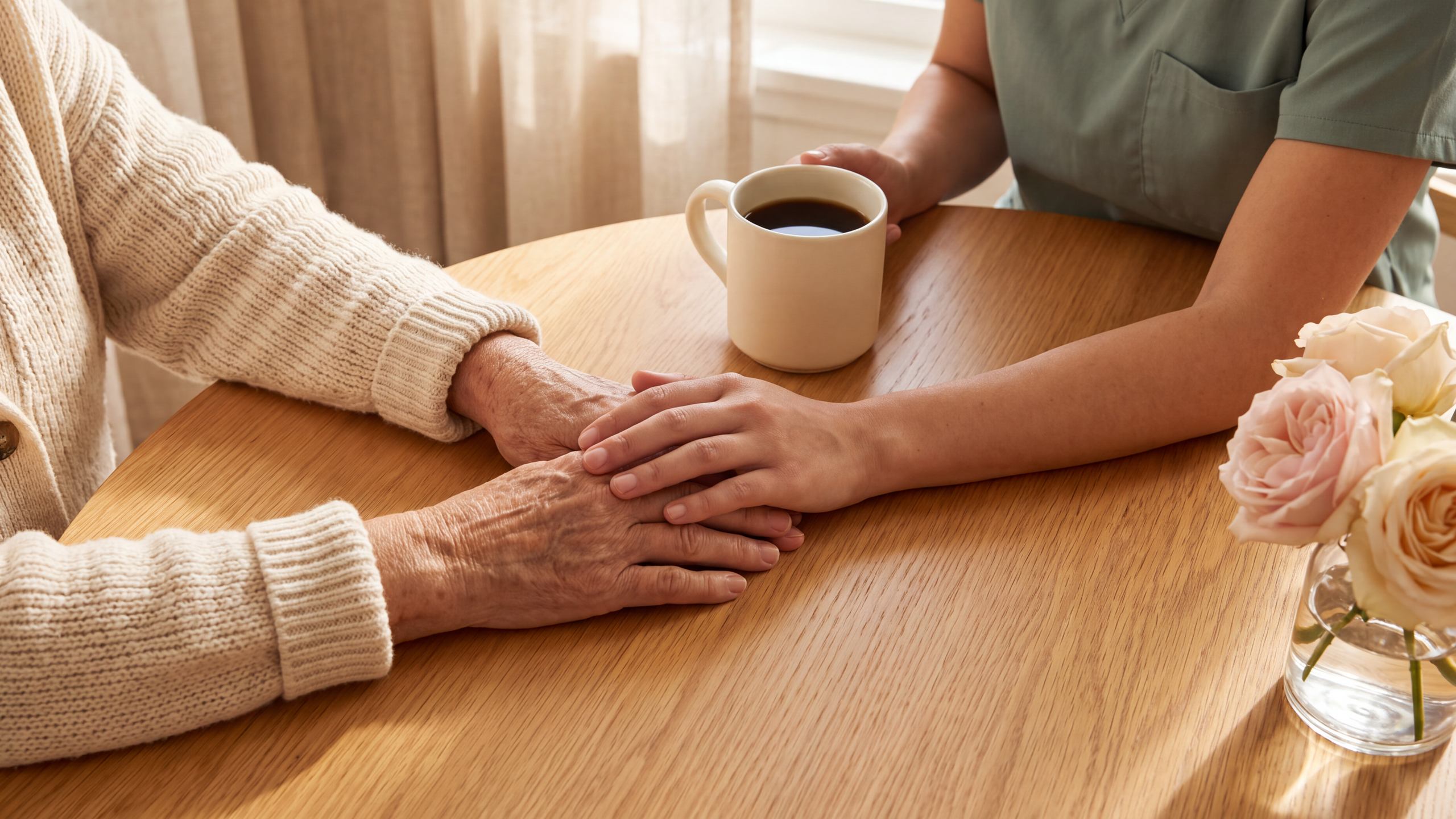
- A registered nurse observes, judges what is abnormal and reports it (California BRN); diagnosis and the choice of medicines stay with your loved one's doctor, nurse practitioner or other licensed prescriber.
- Sudden change needs a closer look: delirium on top of dementia was found in 22% to 89% of people studied (Journal of the American Geriatrics Society, 2002).
- An FDA-approved antipsychotic label carries a boxed warning about a higher risk of death in older adults with dementia-related psychosis.
- People with dementia had nearly 8 times as many falls as people without it in one study (PLoS One, 2009).
- Nurse-led and caregiver support programs improved outcomes in randomized trials, including home visits by specially trained nurses in Germany (JAMA Psychiatry, 2017). Their results are about those programs, not any one provider's.
In this article
- What is a nurse allowed to do for someone with dementia at home?
- What does a dementia nurse visit cover?
- Why does the nurse watch so closely for sudden changes?
- Why does the nurse go through every medicine?
- How can a nurse tell if someone with dementia is in pain?
- Why are falls such a focus on a dementia visit?
- What can a nurse do about sundowning and hard nights?
- How does a nurse support the family caregiver?
- How should you prepare for the first nurse visit?
- What should you ask an in-home dementia nursing provider?
- Where can Orange County and Los Angeles families get help?
- How does WholeHealth Concierge care for families living with dementia?
- Frequently asked questions
- Sources
What is a nurse allowed to do for someone with dementia at home?
A registered nurse observes, judges whether what they see is abnormal, reports or refers it, gives medicines the doctor has ordered, and keeps the person safe. Diagnosis and the choice of medicines stay with your loved one's doctor, nurse practitioner or other licensed prescriber.
The California Board of Registered Nursing's explanation of RN practice (NPR-B-03, revised 2011) describes the core of the job as observing signs and symptoms of illness, reactions to treatment, general behavior and general physical condition, deciding whether they are abnormal, and then reporting, referring or starting emergency procedures. It also covers care for a person's safety, comfort, hygiene and protection, giving medicines and treatments a physician, dentist, podiatrist or clinical psychologist has ordered, and delegating and supervising care that others give. The same document explains that the Medical Practice Act authorizes physicians to diagnose and to use drugs in treatment, and that a registered nurse doing those things generally needs a standardized procedure.
For someone living with dementia, "general behavior" is part of what the nurse is trained to observe, and that is where many visits begin. Our page on in-home dementia care in Orange County covers the home itself: safety, routine and the different types of dementia.
What does a dementia nurse visit cover?
We found no official checklist for a private dementia nurse visit. A useful starting point is the list Medicare uses for its own dementia assessment visit: thinking and memory, daily function, medicines, mood and behavior, safety, support at home and planning ahead. This guide adds three areas the research points to: pain, falls and nights.
CMS describes its cognitive assessment and care plan visit as covering thinking and memory, history and records, daily living and decision-making, staging, high-risk medicines, mood and behavior symptoms, home and driving safety, social supports and planning ahead. That visit is billed by physicians, nurse practitioners, clinical nurse specialists and physician assistants, not by a visiting nurse. It is still the clearest public checklist of what dementia care should look at.
Seven areas to expect, as this guide groups them
This guide's grouping, not an official list, drawn from CMS, Cognitive Assessment & Care Plan Services (page modified October 7, 2026) and the California BRN, An Explanation of the Scope of RN Practice (NPR-B-03, rev. 2011), with the studies named in each row. Your loved one's doctors set the actual plan.
Why does the nurse watch so closely for sudden changes?
Because a sudden change in someone with dementia can be a new medical problem, such as delirium, rather than the dementia itself. A nurse is trained to notice it, compare it with what is usual for your loved one, and report it.
A systematic review in the Journal of the American Geriatrics Society (2002) found delirium on top of dementia in 22% to 89% of hospital and community populations aged 65 and older with dementia, and linked it with poorer outcomes. HealthinAging.org describes delirium as coming on quickly, with symptoms that change often, and says it needs a health professional's attention. It does not always clear quickly: among older hospital patients who had delirium, 44.7% still had it at discharge and 32.8% a month later (Age and Ageing, 2009).
Call 911, or call the doctor today
- Sudden confusion, trouble speaking or trouble understanding speech.
- Sudden numbness or weakness in the face, arm or leg, especially on one side.
- Sudden trouble seeing or walking, dizziness or loss of balance, or a sudden severe headache.
- Note the time the symptoms first appeared.
- A change from their usual self over hours or a few days, such as more confusion or agitation, with no stroke signs.
- A fall without an injury: one fall doubles the chance of another (CDC).
- Anything the doctor asked you to watch for.
Sources: CDC, Signs and Symptoms of Stroke (May 2026) and Facts About Older Adult Falls (September 2026); HealthinAging.org, Delirium (updated February 2024); UCLA Health, Hospital stays can leave elderly patients confused, disoriented (2020). Your loved one's doctors' instructions come first. If in doubt, call 911.
Why does the nurse go through every medicine?
Because some medicines carry extra risk for older adults, and only the prescriber should change them. The nurse checks every bottle against one list and reports concerns to the doctor.
The boxed warning on an FDA-approved antipsychotic label (revised 2020) states that elderly patients with dementia-related psychosis treated with antipsychotic drugs are at an increased risk of death. The American Geriatrics Society's 2023 Beers Criteria is an explicit list of medicines that are potentially inappropriate for adults 65 and older, which its authors say should support, not replace, shared decisions between clinicians and patients. Timing matters too: the Alzheimer's Association suggests talking to the doctor about the best times of day to take medicines when evenings are hard.
Never stop, start or change a medicine on your own. Bring questions to the prescriber, and let the nurse help you write them down.
How can a nurse tell if someone with dementia is in pain?
By watching, not only asking. Tools such as PAINAD score what a nurse can see when a person cannot describe their pain.
The Pain Assessment in Advanced Dementia scale (Warden and colleagues, 2003) was developed in Veterans Administration dementia care units for people with advanced dementia who could not report their pain. It scores five observed items from 0 to 10, and in its development study it detected a difference before and after pain medicine was given. The study was small, 19 residents, but the point for families is simple: pain can be looked for even when it cannot be put into words, and a change in behavior is a reason to ask about it.
Why are falls such a focus on a dementia visit?
Because people living with dementia fall far more often. In one UK study, people with dementia had nearly 8 times as many falls as healthy people over 65 in the comparison group.
That prospective study (PLoS One, 2009) followed 179 people over 65 for a year. Among those with dementia, the risk factors that could be changed included dizziness or a drop in blood pressure on standing that caused symptoms, other autonomic symptoms (from the nerves that run automatic body functions), and depression; more physical activity was protective. The CDC reports that falling once doubles the chance of falling again. Wandering is part of safety too: the Alzheimer's Association says six in 10 people living with dementia will wander at least once, and suggests night lights, door coverings or alerts, and a plan with a recent photo.
Why the visit looks where it does
Figures describe the people each study followed and may not match your loved one's situation.
What can a nurse do about sundowning and hard nights?
Look for what makes evenings worse, build a steadier routine with the family, and bring the doctor in on medicine timing.
The Alzheimer's Association describes sundowning as increased confusion from dusk through the night, with possible contributors such as exhaustion at the end of the day, a mixed-up internal body clock and low lighting. Its suggestions include a regular routine for waking, meals and bed, less stimulation in the evening, a well-lit home in the evening, a larger meal at lunch and a lighter one at night, fewer daytime naps, and less caffeine and alcohol. If nights still need someone awake, our page on overnight and 24-hour nursing at home explains the options.
How does a nurse support the family caregiver?
By teaching, planning and checking on the caregiver as well as your loved one. In randomized trials, support programs run by counselors, care teams and specially trained nurses changed outcomes. Their results are about those programs, not any one provider.
The need is large. The Alzheimer's Association's 2026 Facts and Figures counts more than 7 million Americans living with Alzheimer's and nearly 13 million unpaid caregivers, who gave more than 19 billion hours of care in 2025. Across all conditions, over half of family caregivers manage complex medical and nursing tasks, but just over 20% have formal training on them (AARP and National Alliance for Caregiving, 2025).
What nurse-led and family support has done in trials
Sources: Mittelman et al., Neurology, 2006; Belle et al., Annals of Internal Medicine, 2006; Samus et al., American Journal of Geriatric Psychiatry, 2014; Possin et al., JAMA Internal Medicine, 2019; Thyrian et al., JAMA Psychiatry, 2017. Research on these programs is about those studies, not a measure of any one provider's results.
Medicare is testing support of this kind directly. CMS's GUIDE model, a voluntary program that began on July 1, 2024 and runs for 8 years, asks participating providers to run 24/7 support lines and offer caregiver training and support, and pays for respite of up to $2,500 a year per eligible patient. WholeHealth Concierge is a private-pay practice and does not bill Medicare. For what Medicare does and does not pay at home, see our guide to whether Medicare covers in-home dementia care.
How should you prepare for the first nurse visit?
Gather every medicine, a short list of changes with dates, and your questions, and have the person who knows the daily routine there.
- Every medicine, including over-the-counter drugs, vitamins and herbal supplements, the way Medicare's checklist asks families to list them.
- Changes with dates, and the time if something came on suddenly.
- The person who knows the routine. Medicare's own dementia visit requires someone who knows the person's history to be there.
- Doctors and pharmacies, with phone numbers.
- Any advance directive, since planning ahead is part of dementia care.
- Your questions, written down, including what is hardest for you.
Sources: Medicare.gov, Your discharge planning checklist (December 2025); CMS, Cognitive Assessment & Care Plan Services; CDC, Signs and Symptoms of Stroke.
What should you ask an in-home dementia nursing provider?
Ask who will visit, how you can check their license, what they will write down, and how they reach the doctor when something changes.
- Is the visiting nurse a registered nurse, and may I look up the license? (The state's license search shows whether a license is current and any discipline.)
- If aides help between visits, who employs and supervises them, and which tasks may they do?
- What training in dementia care do your nurses and aides have?
- Will there be a written care plan, who updates it, and how often?
- How do you tell the doctor about a change, and how quickly?
- What happens at night or on a weekend if something changes?
- What will you teach me, and how will you check on how I am doing?
- What do you not do, and who does it instead?
Where can Orange County and Los Angeles families get help?
Start with your county's Caregiver Resource Center, which is free to family caregivers in Orange County.
- Orange County: Caregiver Resource Center OC offers family consultation, assessment, care planning, counseling, respite planning and support groups, free to family caregivers. Phone 800.543.8312 or 714.446.5030.
- Los Angeles and the rest of California: the California Caregiver Resource Centers are 11 nonprofit centers; their site lists the center for each county.
- Licenses: the Board of Registered Nursing for nurses, and the Department of Social Services' licensed home care guidance for aides.
How does WholeHealth Concierge care for families living with dementia?
WholeHealth Concierge is a private-pay concierge nursing practice serving families across Orange County, Los Angeles and the Inland Empire. In our team's own words: "We provide patient, person-centered care that supports safety, routine, dignity and behavior changes, with occupational therapists helping make the home safer. Families get guidance and respite from a team that understands each type of dementia."
Our founder, Meagan Williams, holds California RN license 95328380. You can look it up on the state's license search, and ask us for the license of any nurse who visits.
Every plan starts with a free 15-minute phone consultation. Read more about in-home dementia care in Orange County, or call (213) 298-3288.
Frequently asked questions
Is it safe for someone with dementia to keep driving?
Raise it with the doctor. Driving safety is one of the things CMS lists for Medicare's dementia assessment visit, alongside home safety. Once a person no longer drives, the Alzheimer's Association suggests removing access to car keys.
How is a nurse visit different from a home care aide?
A registered nurse is licensed by the Board of Registered Nursing and is trained to observe and judge changes and report them. In California, home care aides employed by home care organizations must be registered with the Department of Social Services. Ask any aide's employer which tasks its aides may do.
What do registered home care aides in California have to meet?
California's Department of Social Services says registered home care aides have met minimum training requirements, are clear of active tuberculosis and have passed a background check through the department.
Does Medicare pay for a dementia assessment?
Yes, as a separate visit. CMS says Medicare Part B covers a cognitive assessment and care plan visit offered by physicians, nurse practitioners, clinical nurse specialists and physician assistants, with the usual coinsurance and deductible. In-home nursing hours are a different question.
Can delirium last for months?
It can. In a 2009 review of older hospital patients who had delirium, 25.6% still had it at three months and 21% at six months, though the ranges around those figures were wide. Call the doctor today about new or worsening confusion. Call 911 for sudden confusion or trouble speaking or understanding.
How can WholeHealth Concierge help a family living with dementia?
WholeHealth Concierge is a private-pay concierge nursing practice serving families across Orange County, Los Angeles and the Inland Empire. In its team's words, it provides person-centered care that supports safety, routine, dignity and behavior changes. It starts with a free 15-minute phone consultation at (213) 298-3288.
Sources
Statements on this page come from the public sources below, each opened and checked on the date shown. Journal studies were read as their published abstracts. This page is general information for families; your loved one's doctors' advice comes first. WholeHealth Concierge provides nursing care and coordination; diagnosis and prescribing stay with your loved one's physicians and other licensed prescribers.
- California Board of Registered Nursing, "An Explanation of the Scope of RN Practice Including Standardized Procedures," NPR-B-03, revised January 2011. rn.ca.gov (PDF). Accessed November 1, 2026.
- California Board of Registered Nursing, "What is the BRN?" rn.ca.gov. Accessed October 31, 2026.
- Centers for Medicare & Medicaid Services, "Cognitive Assessment & Care Plan Services," page modified October 7, 2026. cms.gov. Accessed November 1, 2026.
- Centers for Medicare & Medicaid Services, Innovation Center, "GUIDE Model," page modified October 27, 2026. cms.gov. Accessed November 1, 2026.
- Fick DM et al., "Delirium superimposed on dementia: a systematic review," Journal of the American Geriatrics Society, 2002. pubmed.ncbi.nlm.nih.gov. Accessed November 1, 2026.
- Cole MG et al., "Persistent delirium in older hospital patients: a systematic review of frequency and prognosis," Age and Ageing, 2009. pubmed.ncbi.nlm.nih.gov. Accessed October 31, 2026.
- HealthinAging.org, "Delirium," last updated February 23, 2024. healthinaging.org. Accessed October 31, 2026.
- Centers for Disease Control and Prevention, "Signs and Symptoms of Stroke," May 19, 2026. cdc.gov. Accessed October 31, 2026.
- Centers for Disease Control and Prevention, "Facts About Older Adult Falls," updated September 4, 2026. cdc.gov. Accessed October 31, 2026.
- Warden V et al., "Development and psychometric evaluation of the Pain Assessment in Advanced Dementia (PAINAD) scale," Journal of the American Medical Directors Association, 2003. pubmed.ncbi.nlm.nih.gov. Accessed November 1, 2026.
- Allan LM et al., "Incidence and prediction of falls in dementia: a prospective study in older people," PLoS One, 2009. pubmed.ncbi.nlm.nih.gov. Accessed November 1, 2026.
- U.S. Food and Drug Administration, approved prescribing information for quetiapine (Seroquel), revised January 2020, an antipsychotic label carrying the boxed warning on dementia-related psychosis. accessdata.fda.gov (PDF). Accessed November 1, 2026.
- American Geriatrics Society 2023 Beers Criteria Update Expert Panel, "American Geriatrics Society 2023 updated AGS Beers Criteria for potentially inappropriate medication use in older adults," Journal of the American Geriatrics Society, 2023. pubmed.ncbi.nlm.nih.gov. Accessed November 1, 2026.
- Alzheimer's Association, "Wandering." alz.org. Accessed November 1, 2026.
- Alzheimer's Association, "Sleep Issues and Sundowning." alz.org. Accessed November 1, 2026.
- Alzheimer's Association, "Alzheimer's Disease Facts and Figures," 2026. alz.org. Accessed November 1, 2026.
- Mittelman MS et al., "Improving caregiver well-being delays nursing home placement of patients with Alzheimer disease," Neurology, 2006. pubmed.ncbi.nlm.nih.gov. Accessed November 1, 2026.
- Belle SH et al., "Enhancing the quality of life of dementia caregivers from different ethnic or racial groups: a randomized, controlled trial," Annals of Internal Medicine, 2006. pubmed.ncbi.nlm.nih.gov. Accessed November 1, 2026.
- Samus QM et al., "A multidimensional home-based care coordination intervention for elders with memory disorders: the maximizing independence at home (MIND) pilot randomized trial," American Journal of Geriatric Psychiatry, 2014. pubmed.ncbi.nlm.nih.gov. Accessed November 1, 2026.
- Possin KL et al., "Effect of Collaborative Dementia Care via Telephone and Internet on Quality of Life, Caregiver Well-being, and Health Care Use: The Care Ecosystem Randomized Clinical Trial," JAMA Internal Medicine, 2019. pubmed.ncbi.nlm.nih.gov. Accessed November 1, 2026.
- AARP and National Alliance for Caregiving, Caregiving in the U.S. 2025 (press release), July 24, 2025. aarp.org. Accessed October 31, 2026.
- Centers for Medicare & Medicaid Services, "Your discharge planning checklist," CMS Product No. 11376, December 2025. medicare.gov (PDF). Accessed October 31, 2026.
- California Department of Social Services, "Fact Sheet: Licensed Versus Unlicensed Home Care Services," April 2022. cdss.ca.gov (PDF). Accessed October 31, 2026.
- Thyrian JR et al., "Effectiveness and Safety of Dementia Care Management in Primary Care: A Randomized Clinical Trial," JAMA Psychiatry, 2017. pubmed.ncbi.nlm.nih.gov. Accessed November 1, 2026.
- UCLA Health, "Hospital stays can leave elderly patients confused, disoriented," December 2, 2020 (WholeHealth Concierge is not affiliated with UCLA Health). uclahealth.org. Accessed October 31, 2026.
- California Department of Consumer Affairs, License Search. search.dca.ca.gov. Accessed November 1, 2026.
- Caregiver Resource Center OC. caregiveroc.org. Accessed October 31, 2026.
- California Caregiver Resource Centers. caregivercalifornia.org. Accessed October 31, 2026.