Which utility actually serves your address?
Two utilities cover the Coachella Valley, and the boundary between them does not follow city lines. Southern California Edison serves most of the valley. The Imperial Irrigation District, a publicly owned irrigation district rather than an investor-owned utility, also serves a substantial share, including all of Imperial County and parts of Riverside County.
Here is why a city name will not settle it: Palm Desert, Rancho Mirage and Indio each appear on both utilities' own published service lists. Those three cities are genuinely split, address by address. Coachella and La Quinta are IID service areas, while Palm Springs, Cathedral City and Desert Hot Springs are SCE. Thousand Palms and the city of Indian Wells are also split between the two.
What this page covers
What does IID actually offer a medically fragile household?
IID restructured its entire assistance program lineup on 1 January 2026. If you have seen the old program name MEEUAP anywhere, including in search results, that program no longer exists under that name. The current program is called EASE, Energy Assistance for Special Equipment, and it works differently from its predecessor: it reduces the electrical rate for a defined quantity of electricity used to operate medical equipment for a household with a full-time resident who requires the use of electric devices for medical reasons, and IID states it is available to all qualified customers regardless of income.
IID also restructured its income-based assistance programs at the same time: the former REAP is now called READY, and the former EEAP is now called CARE. If older material online quotes REAP or EEAP figures, treat it as superseded and confirm current terms directly with IID rather than trusting the old numbers.
To apply for EASE, or for READY or CARE, IID's application centers are in Brawley, Calexico and El Centro, all in Imperial County, plus one Coachella Valley location: La Quinta, 81-600 Avenue 58. Office hours at all four centers are Monday through Thursday, 8 a.m. to noon and 1 to 5 p.m., closed Fridays. These are application centers, not a general walk-in outage counter.
Both numbers and the IID Connect app and Customer Connect portal are current as of 17 August 2026. Confirm current EASE application requirements directly with IID before relying on any third-party summary, including this one, since the program changed recently.
What does SCE actually offer a medically fragile household?
SCE's Medical Baseline Allowance is a rate program, not a subsidy check and not a backup power source. It provides an additional 16.5 kWh per day of electricity at the lowest, cheapest baseline rate. Customers on SCE's TOU-D PRIME time-of-use rate specifically may qualify for a flat 11% discount instead.
Three ways a household can qualify: use of life-support equipment, a medical condition causing sensitivity to temperature that requires air conditioning, or a condition requiring heating or cooling to prevent a medical emergency. That third pathway means a frail older adult can qualify without owning any powered medical device at all, purely on heat sensitivity, though a licensed medical professional, an MD, DO, PA or NP, must still complete and sign the application. SCE's device list for the life-support pathway includes oxygen generators, CPAP and apnea monitors, dialysis machines, respirators and motorized wheelchairs, though SCE is specific that devices used for therapy but not medically required for sustaining life do not qualify.
To apply: online through DocuSign, by mail, or by calling 1-800-655-4555 (Monday through Friday, 8 a.m. to 5 p.m.) for general assistance. SCE routes phone-based Medical Baseline applications specifically to 1-866-229-9360, and that phone route is for permanent conditions only. Approval typically takes one to two billing cycles. Recertification is required every two years for a temporary condition and every four years for a permanent one.
Does either program guarantee the power stays on?
No, and it is worth being direct about this rather than letting a family assume a medical program equals a service guarantee. Neither SCE's Medical Baseline Allowance nor CPUC's own program description contains any statement of shutoff protection or a service guarantee. IID's live guidance for critical care medical device households promises "every effort," not a guarantee, and commits to no advance notification.
Medical Baseline is specifically a program of the CPUC-regulated investor-owned utilities: PG&E, SCE, SoCalGas and SDG&E. IID is a publicly owned irrigation district and is not rate-regulated by the CPUC, so it does not offer Medical Baseline; its equivalent is EASE, described above, which is a different kind of program with a different set of terms.
The practical conclusion is the one both utilities point toward without quite saying it outright: a household that depends on powered medical equipment needs its own backup plan, not a document that promises the utility will keep the lights on.
Where are the nearest cool centers?
The Community Action Partnership of Riverside County publishes an annual Cool Center Directory. The current version, dated 11 August 2026, lists 19 sites inside the Coachella Valley: Indio 4, Palm Desert 3, Desert Hot Springs 2, Palm Springs 2, Mecca 2, and one each in Cathedral City, Coachella, La Quinta, North Shore, Thermal and Thousand Palms. Rancho Mirage and Indian Wells currently have none listed.
The season runs from June 1 through the warm months. There is no single countywide temperature that triggers every site to open; hours and activation vary by location. Call 211 or the site directly to confirm hours before traveling, particularly with a medically fragile passenger, since an unnecessary trip in a hot car carries its own risk.
What happens to refrigerated medication and powered equipment during an outage?
This is where an outage becomes a medical event rather than an inconvenience, and it is worth planning for specifically rather than assuming it will sort itself out.
Insulin and other refrigerated medications
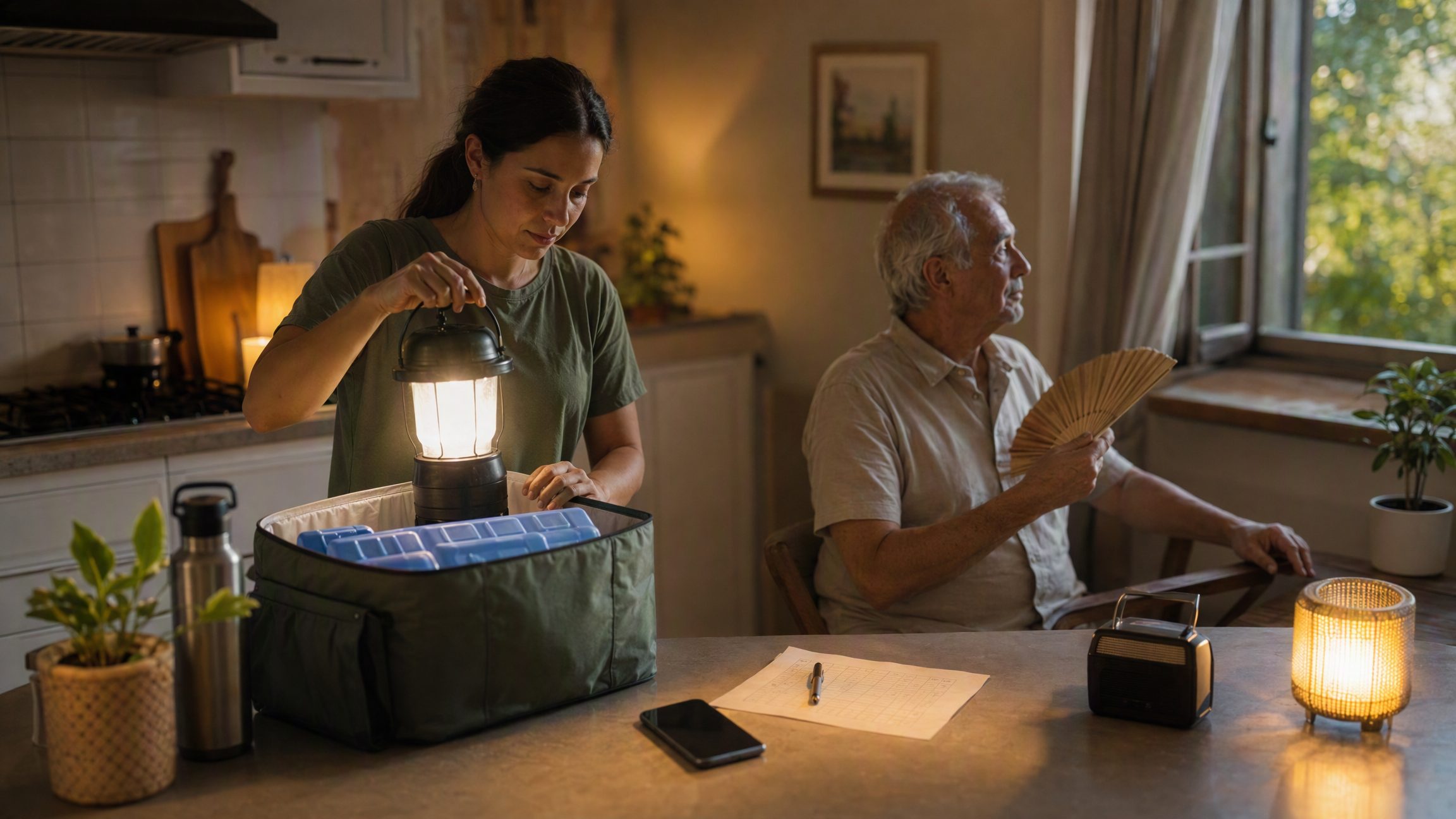
FDA guidance on insulin during an emergency, content dated 19 September 2017, advises that unopened and opened insulin can generally be kept at room temperature, away from direct heat and light, for a period that varies by product, and that insulin should never be used if it has been exposed to extreme heat. Because this guidance is nearly nine years old and insulin products change, confirm current storage guidance for the specific product with the pharmacist or manufacturer before an emergency, not during one. A cooler with ice packs, prepared in advance, is the practical backup for any refrigerated medication during a multi-hour outage.
Oxygen concentrators, CPAP machines and other powered devices
A device that depends on continuous power needs its own outage plan, separate from any utility program. That plan is a conversation with the equipment supplier and the prescribing clinician: what backup power the device supports, how long a battery backup lasts, and what the plan is if the outage runs longer than that. This is precisely the situation SCE's Medical Baseline and PSPS notification, and IID's EASE program, are meant to support with rate relief and, for SCE PSPS events specifically, advance notice. Neither is a substitute for a device-specific backup plan built with the equipment supplier.
How hot does it actually get, and when?
Palm Springs holds the all-time record for the station at 124°F, set 5 July 2024. So far in 2026, the highest recorded temperature is 117°F, reached twice: 25 July and again 1 August. Several other days in late July and early August 2026 reached 115°F or higher.
By the 1991-2020 climate normals, the hottest stretch of the calendar year runs from about 19 through 31 July, when the normal daily high sits at 109°F. July's monthly average high is 108.6°F and August's is 108.1°F, both extreme by any standard, though the single hottest window of the year is that last third of July specifically, not the full six-week span sometimes claimed.
The National Weather Service treats the Coachella Valley as its own, hotter zone within Riverside County. On 22 July 2026, the same NWS release carried a Heat Advisory at 108°F for the county's western valleys and a more serious Extreme Heat Warning at 118°F specifically for the Coachella Valley and San Gorgonio Pass, covering the same dates. That ten-degree gap in the same county, on the same day, is the clearest illustration of how much hotter the desert floor runs than the rest of the region.
What that heat costs, in emergency department visits
Riverside County recorded 1,627 heat-related emergency department visits and 65 deaths in 2024, the highest volume and deaths both falling in July. In 2025 the county recorded 1,027 visits and 21 deaths, peaking in August instead. By late July 2026, the county had already logged 732 visits and three deaths year-to-date, with the highest weekly totals of the year so far falling in the first two weeks of July, and the hottest weeks of the year still to come at that point. Two years of falling numbers is not evidence that the risk is declining; both years are single data points against a great deal of year-to-year weather variation.
One further county finding is worth including with its correct meaning attached. Riverside County's own Data Digest found that among Riverside County residents who died in 2023, 5.4% of unhoused decedents died from heat-related illness compared with 0.1% of housed decedents, a figure the county itself describes as unhoused residents being roughly 38 times more likely to die from heat. That comparison is a share of deaths, not a population risk rate, and it is worth stating precisely: it describes who heat killed among people who died, not the odds any one person faces.
- Which utility serves which communities, and why city name alone does not settle it: IID service territory map, SCE's CPUC-filed tariff Index of Communities, and CPUC Devers-Mirage Draft EIR, cross-checked 17 August 2026.
- IID's EASE, READY and CARE programs, replacing MEEUAP, REAP and EEAP effective 1 January 2026: iid.com/paymentassistance and IID board action posted 12 January 2026.
- IID critical care medical device outage guidance: iid.com, Report a Power Outage, retrieved live 17 August 2026.
- SCE Medical Baseline Allowance, TOU-D PRIME discount, and PSPS notification: SCE Medical Baseline fact sheet and program page.
- SCE Critical Care Backup Battery Program and its high fire risk area requirement: sce.com, Critical Care Backup Battery Program page.
- Insulin storage during an emergency: FDA, content current as of 19 September 2017. Confirm current product-specific guidance before relying on this date.
- Cool center locations and counts: Community Action Partnership of Riverside County, 2026 Cool Center Directory, dated 11 August 2026.
- Temperature records and normals: NOAA climate data for the Palm Springs station, queried 17 August 2026.
- Heat-related emergency department visits and deaths, 2024 through 2026 year-to-date: Riverside University Health System, Public Health press releases dated 6 August 2025 and 22 July 2026.
- Unhoused mortality comparison: Riverside County Data Digest, September 2024.
- Statewide and regional excess mortality, 2022 heat wave: California Department of Public Health, Office of Health Equity, August 2023.
What families say
Careful, sourced preparation is the same standard applied to every part of the work.
“Meagan was wonderful at a difficult time for us. She arrived almost immediately and helped get my husband the care he needed and the equipment through Medicare. We are so appreciative.”
“This is the most comprehensive management and provision of high skill level nursing care I have ever experienced. The level of knowledge, skills, and experience are phenomenal. I highly recommend this company.”
The utility programs help with the electric bill. The medical plan is worth building separately.
Fifteen minutes with Meagan Williams, RN, BSN, CCRN, to think through a heat-and-outage plan for an aging or medically fragile family member. No pressure, no obligation.
Power outages and heat in the Coachella Valley, answered.
How do I find out which utility serves my address in the Coachella Valley?
Do not rely on the city name. Palm Desert, Rancho Mirage and Indio each appear on both the Imperial Irrigation District's and Southern California Edison's own published service lists, because those cities are genuinely split between the two utilities address by address. Use IID's address search tool at iid.com, check a recent SCE bill, or call SCE directly to confirm which utility actually serves a specific home.
What is IID's EASE program, and what happened to MEEUAP?
IID restructured its assistance programs effective 1 January 2026. The former MEEUAP program is now called EASE, Energy Assistance for Special Equipment, and it reduces the electrical rate for a household with a resident who requires electric devices for medical reasons. IID states EASE is available to all qualified customers regardless of income. If you see the name MEEUAP or old REAP or EEAP figures online, that material is out of date; confirm current terms directly with IID.
Does SCE's Medical Baseline Allowance guarantee my power stays on?
No. Medical Baseline is a rate program that provides an additional 16.5 kWh per day at the cheapest rate tier, or a flat 11% discount for customers specifically on the TOU-D PRIME rate. It is not a service guarantee, a subsidy check or backup power. The one real protection it adds is advance notification before a Public Safety Power Shutoff wildfire-prevention outage, which does not cover ordinary heat-driven or equipment-failure outages.
Can I qualify for medical rate assistance without owning a powered medical device?
Yes. SCE's Medical Baseline Allowance has three qualifying pathways: use of life-support equipment, a medical condition causing temperature sensitivity that requires air conditioning, or a condition requiring heating or cooling to prevent a medical emergency. The temperature-sensitivity pathway does not require owning a device, though a licensed medical professional, an MD, DO, PA or NP, must still complete and sign the application.
Am I eligible for SCE's free Critical Care Backup Battery?
Only if you live within an SCE-designated high fire risk area and are already enrolled in Medical Baseline. Most of the Coachella Valley floor is not in that zone, so most households in the valley will not qualify for this specific program even though it is free where it applies. Confirm eligibility directly with SCE at 1-800-736-4777 before counting on it.
Where is the nearest cool center in the Coachella Valley?
The Community Action Partnership of Riverside County's 2026 Cool Center Directory, dated 11 August 2026, lists 19 sites across the valley, concentrated in Indio, Palm Desert, Desert Hot Springs, Palm Springs and Mecca, with none currently listed in Rancho Mirage or Indian Wells. Hours vary by location and there is no single countywide activation temperature, so call 211 or the site directly to confirm hours before traveling.
What should I do about refrigerated medication during a power outage?
FDA guidance on insulin during an emergency states that many insulin products can be kept at room temperature, away from direct heat and light, for a period that varies by product, and should never be used after exposure to extreme heat. Because storage guidance is product-specific and can change, confirm current instructions with the pharmacist for the exact medication rather than relying on a general rule, and keep a cooler with ice packs prepared in advance as a practical backup during a multi-hour outage.
Does WholeHealth Concierge provide outage response or medical equipment in the Coachella Valley?
No. WholeHealth Concierge has no office in the Coachella Valley and does not provide outage response, medical equipment, or on-site services there. This page is preparation education compiled from the utilities' own current programs and public health data. What a registered nurse can help with is building a heat-and-outage plan for an aging or medically fragile family member, wherever that conversation is useful.