What does the evidence actually show, and what doesn't it show?
Every study cited on this page is either an observational study, meaning it found a statistical association, not a proven cause, or a modeled projection of the future, meaning it is a forecast, not an observation. None of them proves that heat causes dementia to progress. That distinction matters, and this page will not blur it to make a more dramatic headline.
What the evidence does show is a real, repeated, worth-taking-seriously association. A 2026 study of adults 71 and older found that people with more cumulative heat exposure over a 3-year period had 9.2% higher odds of a new dementia diagnosis than people with less exposure, after adjusting for age, sex, and other factors. A large 2026 review pooling 578 studies drawn from 623 eligible studies across six continents rated the evidence "sufficient" that heat and heat waves raise both illness and death risk in older adults generally, though that review was not limited to dementia specifically.
What this page covers
Why might heat affect someone with dementia differently?
There is a plausible biological story here, and it is important to be honest about how solid it is. A 2021 narrative review in Environmental Research summarizing research on climate and neurodegenerative disease describes thermoregulation, the body's system for managing its own temperature, as already compromised in people with Alzheimer's disease and related conditions, and discusses candidate mechanisms including excitotoxicity, oxidative stress and neuroinflammation as ways heat exposure might interact with an already-vulnerable brain.
The review's own authors are careful about how far this goes. Their own conclusion states that the link between global warming and the increased prevalence of neurodegenerative disease "remains elusive." This is a catalog of plausible mechanisms, not a settled explanation. It is worth knowing this science exists. It is not evidence that a specific mechanism has been proven.
Does room temperature affect agitation in people who already have dementia?
This is the single most directly relevant study in the research behind this page, because it is the only one that measured a real behavioral outcome in real people who already had dementia, rather than inferring something from a broader population. A 2017 study followed 21 residents with dementia in a single nursing home over 10 months, using a standard agitation scale (the Cohen-Mansfield Agitation Inventory) alongside continuous indoor temperature monitoring.
Agitation scores rose significantly when the indoor average temperature deviated from a reference point of about 22.6°C (73°F). Cumulative exposure to indoor temperatures above 26°C (79°F) and below 20°C (68°F) was linearly correlated with higher total agitation frequency. In plain terms: in this one facility, agitation tracked with temperature deviation in both directions, not only heat.
Does a person with dementia notice heat less than everyone else?
This is the assumption behind a lot of casual advice about dementia and hot weather, and the best available study on the question found something more specific, and in one respect the opposite of what people expect.
A 2020 study compared 69 residents across 15 UK residential care facilities, 34 with dementia and 35 without, measuring both self-reported thermal sensation and objective skin and ambient temperature. Thermal sensation genuinely differed between the two groups. But the discordance ran toward feeling cool, not hot: residents with dementia reported feeling cool or slightly cool far more often than residents without dementia, and their fingertip skin temperature and the ambient temperature of their living spaces were both measurably lower.
Read that carefully, because it does not say what it is often assumed to say. This study does not show that people with dementia fail to notice or under-report heat. If anything, in this sample, they were being kept, or were gravitating toward, cooler conditions than residents without dementia. That is a genuinely different and more useful finding than "they won't tell you they're hot," and it argues for checking on room temperature directly rather than relying on either the person's report or an assumption about what dementia does to heat perception.
If dementia and medication timing are both part of the picture, the related reading is which medications make heat more dangerous.
Which medications raise the stakes, and what does the label actually say?
Antipsychotics, anticholinergic medications and certain other psychotropics are common in dementia care, prescribed for real reasons, and they interact with heat in ways worth understanding. The CDC's clinical guidance for clinicians, dated 18 September 2025, states plainly that commonly prescribed medications that increase risk from heat include diuretics, anticholinergic agents, and some psychotropic medications, and separately lists interference with central thermoregulation as a mechanism attributed to antipsychotics, anticholinergics and stimulants.
FDA-approved prescribing information for the antipsychotic quetiapine, brand name SEROQUEL, carries a section titled Body Temperature Regulation, which states: "Although not reported with SEROQUEL, disruption of the body's ability to reduce core body temperature has been attributed to antipsychotic agents." The same section advises appropriate care "for patients who will be experiencing conditions which may contribute to an elevation in core body temperature, e.g., exercising strenuously, exposure to extreme heat, receiving concomitant medication with anticholinergic activity, or being subject to dehydration." A 2015 clinical commentary in the Journal of Clinical Pharmacy and Therapeutics summarizes the combined mechanisms of these medication classes as diuresis and electrolyte imbalance, sedation and cognitive impairment, changed thermoregulation, reduced thirst recognition, reduced sweat production, and hypotension with reduced cardiac output, attributing the highest risk to diuretics combined with an ACE inhibitor or ARB, anticholinergics, and psychotropics together.
Is there research on heat and dementia hospitalization specifically in the US?
Yes, one study, and it deserves to stand on its own rather than be compared side by side with very different overseas figures. A 2025 case-crossover analysis of US Medicare beneficiaries with a prior dementia-related hospitalization found that on extreme heat days, the hottest 1% of days by heat index, the odds of an all-cause hospitalization were 1.7% higher than on a typical day in the same warm season.
That 1.7% figure sometimes gets placed next to much larger numbers from studies conducted in other countries, describing very different outcomes: an Australian study on dementia hospitalizations after multi-day heatwaves, and a Chinese study on dementia mortality under extreme multi-day heat. Those numbers are not comparable to the US figure. They measure different outcomes, over different time windows, using different heat definitions, in different health systems. The fair statement is that this is the one US effect size that currently exists for this specific question, and it should be read on its own terms rather than ranked against studies built entirely differently.
What can a family actually do?
The CDC's public guidance for older adults, current as of 25 June 2024, recommends checking in on someone at risk at least twice a day during hot weather, and asking four specific questions: are they drinking enough water, do they have access to air conditioning, do they know how to keep cool, and are they showing any signs of heat stress. That guidance is written for older adults generally, not specifically for dementia, but the checklist becomes more important, not less, when the person being checked on may not reliably report their own condition.
The Alzheimer's Association's own emergency preparedness guidance for extreme heat covers several practical points worth building into a summer routine: making a plan in advance for cooler spaces if air conditioning is unavailable, dressing in light clothing, paying particular attention at night since indoor temperatures can remain elevated with little relief, watching for behavioral changes that may signal physical discomfort rather than emotional distress, increasing water intake, staying informed on forecasts, and taking extra wandering precautions, since a person who is uncomfortable may attempt to leave the house looking for relief.
Given the research above, three things worth prioritizing
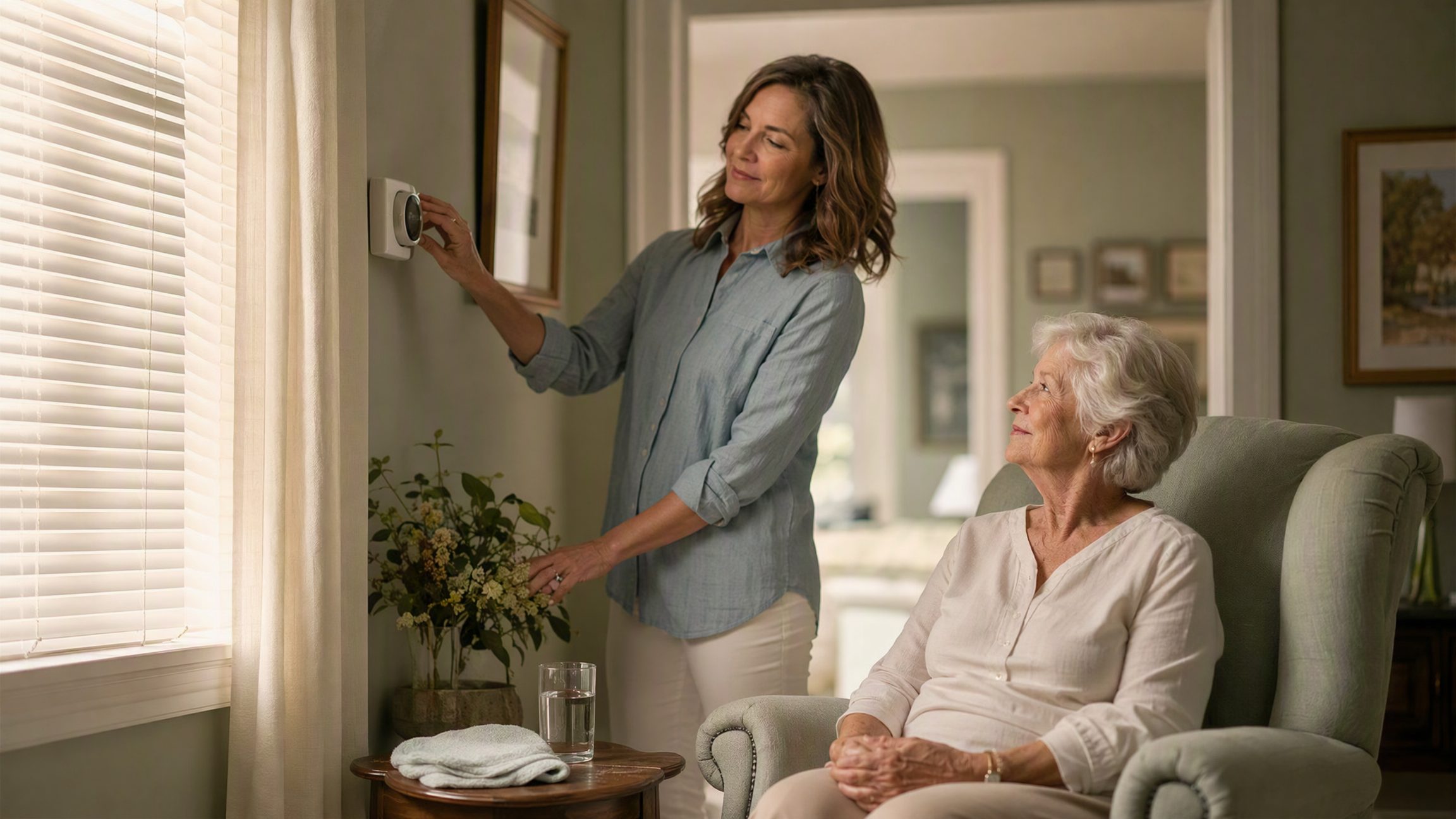
- Watch the room, not just the person's report. The most direct dementia-specific evidence on this page found agitation tracked with indoor temperature deviation. A thermometer in the main room is a genuinely useful, low-effort tool.
- Do not assume "they'll tell you if they're hot." The best available study found the opposite pattern in its sample: residents with dementia reported feeling cool more often, not less. Check the room and the person directly rather than waiting to be told.
- If antipsychotics or anticholinergic medications are part of the regimen, bring the heat question to the prescriber before summer, not during a heat event, using the mechanisms above as the starting point for the conversation.
- 9.2% higher odds of dementia onset with 3-year heat exposure, and the 23.4% combined dementia-or-death figure: Morita et al., Alzheimer's & Dementia 2026;22(1):e71057.
- Agitation and indoor temperature deviation in dementia, 21 residents, one nursing home, 10 months: Tartarini et al., American Journal of Alzheimer's Disease & Other Dementias 2017;32(5):272-281.
- Thermal sensation discordance running toward cool, not hot, 69 residents across 15 UK facilities: Childs et al., International Journal of Environmental Research and Public Health 2020;17(18):6932.
- Candidate biological mechanisms, with the authors' own "remains elusive" caveat: Bongioanni et al., Environmental Research 2021;201:111511.
- Medication mechanisms and the "expert opinion" caveat: CDC, Heat and Medications, Guidance for Clinicians, dated 18 September 2025.
- General older-adult heat risk and the twice-daily caretaker checklist: CDC, Heat and Older Adults (Aged 65+), dated 25 June 2024.
- Quetiapine (SEROQUEL) prescribing information, Body Temperature Regulation section: AstraZeneca SEROQUEL label, FDA-approved prescribing information effective 22 January 2025.
- Combined mechanism summary and highest-risk combinations: Westaway et al., Journal of Clinical Pharmacy and Therapeutics 2015;40(4):363-367.
- Anticholinergic burden in nursing home residents with dementia: Chatterjee et al., Drugs & Aging 2010;27(12):987-997, based on 2004 national survey data.
- US Medicare all-cause hospitalization odds on extreme heat days: Spoto et al., Environmental Epidemiology 2025;9(6):e440.
- Global evidence review, 623 eligible studies, six continents: Gunsche et al., Environment International 2026;208:110129.
- Caregiver emergency preparedness guidance for extreme heat: Alzheimer's Association, Preparing for Emergencies, retrieved 17 August 2026.
What families say
Careful, sourced answers are the same standard applied to dementia care coordination.
“Meagan was wonderful at a difficult time for us. She arrived almost immediately and helped get my husband the care he needed and the equipment through Medicare. We are so appreciative.”
“This is the most comprehensive management and provision of high skill level nursing care I have ever experienced. The level of knowledge, skills, and experience are phenomenal. I highly recommend this company.”
A registered nurse can help make sense of what comes next.
Fifteen minutes with Meagan Williams, RN, BSN, CCRN, is usually enough to talk through where things stand, what questions are worth bringing to the neurologist or primary care physician, and how care coordination actually works. No pressure, no obligation.
Heat and dementia, answered honestly.
Does heat make dementia worse?
The evidence shows a real association, not a proven cause. A 2026 study found people with more cumulative heat exposure over three years had 9.2% higher odds of a new dementia diagnosis than people with less exposure, after adjusting for other factors. A separate 2026 review of 623 eligible studies across six continents rated the evidence "sufficient" that heat raises illness and death risk in older adults generally. Neither finding proves that heat causes dementia to develop or progress. Both are observational associations, which is a meaningful thing to know without being the same thing as proof.
Does a person with dementia notice heat less than everyone else?
Not in the way that assumption usually means. A 2020 study comparing residents with and without dementia across 15 UK care facilities found that residents with dementia reported feeling cool or slightly cool far more often than residents without dementia, and were also kept in measurably cooler rooms. The discordance ran toward cool, not hot. This does not show that people with dementia fail to notice heat. It argues for checking the room's actual temperature directly rather than relying on either the person's report or an assumption about how dementia affects heat perception.
What indoor temperature is best for someone with dementia?
The most directly relevant study, following 21 dementia residents in one nursing home over 10 months, found agitation scores rose when indoor temperature deviated from about 22.6°C (73°F), with cumulative time above 26°C (79°F) or below 20°C (68°F) linearly correlated with more agitation. That is a single-site study of 21 people, so treat it as a useful reference point rather than a fixed rule, and note that both too hot and too cold were associated with more agitation, not heat alone.
Which medications raise heat risk for someone with dementia?
The CDC's clinical guidance names diuretics, anticholinergic medications and certain psychotropic medications, including antipsychotics, as raising heat risk through mechanisms like reduced thirst recognition, decreased sweating, and interference with the brain's temperature control. FDA prescribing information for the antipsychotic quetiapine specifically warns of disrupted core body temperature regulation. None of this means a medication should be stopped. It means the heat question is worth raising with the prescribing clinician, especially before summer rather than during a heat event.
Is it true that most dementia patients are on medications that make heat worse?
A commonly repeated figure says nearly three in four nursing home residents with dementia are on an anticholinergic medication, but that number includes drugs with only minimal anticholinergic activity. The figure that reflects real, clinically meaningful anticholinergic burden is closer to one in five. Both numbers come from national survey data that is now roughly two decades old, so they describe historical patterns rather than a confirmed current rate.
Is there US research specifically on heat and dementia hospitalization?
Yes, one study. A 2025 analysis of US Medicare beneficiaries with a prior dementia-related hospitalization found 1.7% higher odds of an all-cause hospitalization on the hottest 1% of days compared with a typical day in the same season. This figure should not be compared numerically against much larger figures from studies in other countries, since those measure different outcomes over different time windows using different definitions of extreme heat.
What can a family actually do to keep someone with dementia safe in the heat?
Check on the person and the room at least twice a day during hot weather, per CDC guidance, watching for adequate water intake, working air conditioning or another way to cool the space, and any early signs of heat stress. Watch the room's actual temperature rather than relying on self-report. The Alzheimer's Association also recommends planning cooler locations in advance, dressing in light clothing, paying extra attention at night, watching for behavioral changes that may signal discomfort, and taking extra wandering precautions, since heat discomfort can prompt a person to try to leave the house looking for relief.
Does WholeHealth Concierge provide caregiving or companion care for heat season?
No. WholeHealth Concierge is a private nursing practice offering health education, dementia care coordination, and family advocacy. It does not provide companion care, personal care, or hands-on caregiving services, and this page should not be read as an offer of those services. A registered nurse can help a family understand a diagnosis, prepare questions for the care team, and build a coordinated plan.