Private duty nursing, one-to-one care from a licensed home nurse.
Skilled one-to-one nursing for as many hours as the situation needs, without the 28-hour ceiling that limits Medicare home health. Placed and clinically supervised by Meagan Williams, RN, BSN, CCRN, across Orange County, Los Angeles, Riverside and San Bernardino.

What is private duty nursing?
Private duty nursing is skilled nursing care delivered one-to-one to a single person, usually at home, for extended or continuous hours. A licensed nurse is assigned to your family member and only your family member, for the length of the shift.
That is the whole distinction. Other home care models are built around brief visits, or around non-medical help. Private duty nursing is built around a nurse being present, doing clinical work, for a block of hours you choose.
The work is genuinely clinical: wound and drain management, IV antibiotics and infusion, tracheostomy and ventilator support, feeding tube care, catheter care, complex medication administration, and continuous observation of someone whose condition can turn quickly.
What is the difference between private duty nursing and home health?
Hours and who pays. That is it, and it is the most useful thing to understand before you start calling agencies.
Medicare home health is part-time and intermittent by design. In Medicare's own words, “part-time or intermittent” means you may get skilled nursing and home health aide services up to 8 hours a day (combined), for a maximum of 28 hours a week, with up to 35 hours possible for a short time if a provider decides it is necessary (Medicare, Home health services).
Twenty-eight hours a week is four hours a day. If your loved one needs someone overnight, or cannot safely be left alone at all, home health does not stretch to cover it. It was never built to.
Private duty nursing has no such cap, because it is not an insurance benefit. You buy the hours the situation needs, whether that is an evening shift, overnights, or around the clock.
There is also an eligibility gate families do not expect: home health generally requires a physician's order and that the patient be considered homebound. Private duty nursing has no homebound requirement. If your loved one wants to attend a grandchild's wedding with a nurse alongside them, that is allowed.
For the fuller side-by-side, including where an agency is genuinely the better answer, read concierge nursing versus home health.
Does Medicare cover private duty nursing?
No. This is the answer families least want and most need on day one.
Medicare's own long-term care page carries a plain banner: “Medicare doesn't pay for long-term care”, marked Not Covered. You pay all costs (Medicare, Long-term care). The federal Benefit Policy Manual likewise excludes private-duty nurses and private-duty attendants from covered services (CMS Benefit Policy Manual).
We walk through the exceptions, the eight-hour rule and what Medicare will pay for in our full explainer on whether Medicare covers private duty nursing. So the realistic funding routes are private pay, a long-term care insurance policy, or VA benefits for a qualifying veteran or surviving spouse. If a policy is in play, the mechanics matter enormously, and we cover them in our guide to whether long-term care insurance will pay for a private nurse.
A family that learns this in week one plans very differently from a family that learns it in week three. Anyone who lets you believe Medicare will fund ongoing private duty hours is either mistaken or selling.
Who actually comes to the house, an RN or an LVN?
Either can, and the honest answer is that most private duty schedules are a mix. A Registered Nurse covers assessment and complex clinical judgment; a Licensed Vocational Nurse covers routine clinical tasks under RN direction. Ask early which license covers which hours, because the two are not interchangeable and pricing reflects the difference.
A Registered Nurse is licensed by the California Board of Registered Nursing. Under state law an RN administers medications and therapeutic agents to carry out a regimen ordered by a physician or other authorized prescriber, and performs skilled assessment (California Business and Professions Code § 2725). The assessment piece is what matters at three in the morning: recognizing that a change in breathing or mental status needs a call now rather than at the next appointment.
A Licensed Vocational Nurse is licensed by a separate board (California Board of Vocational Nursing and Psychiatric Technicians) and works within a narrower scope, generally under RN or physician direction.
A caregiver, companion or home health aide holds no nursing license at all. They are frequently the right answer and often wonderful, but they cannot assess, and they cannot legally perform the clinical tasks above.
None of this makes an LVN shift wrong. A stable overnight where the need is watchfulness and routine medication may be well served by an LVN at lower cost. It becomes a problem only when a family believes it is buying RN hours and is not.

When does a family actually need private duty nursing?
The honest test is whether the work requires a license. If what is needed is company, meals, bathing and reminders, a caregiver is the better and cheaper fit, and we will say so. Private duty nursing is warranted when the situation includes:
- Post-surgical recovery with wound care, drain management or IV antibiotics
- Complex or high-risk medication regimens, particularly insulin, anticoagulants or opioids
- Tracheostomy, ventilator or feeding tube support at home
- Active cancer treatment with infusion, port care or symptom management
- Chronic conditions that change quickly, such as heart failure, COPD or advanced kidney disease
- Recovery from stroke, traumatic injury or a neurological event
- Overnight coverage where the risk is falls, wandering or an unwitnessed decline
- Hospice or palliative situations where a family wants continuous skilled presence
When the hospital stay included time in intensive care, our page on home nursing after an ICU stay explains post-intensive care syndrome and what the first weeks at home can look like.
How many hours can you get, and is 24-hour care possible?
Yes, and it is built from shifts rather than one person staying indefinitely. Around-the-clock coverage normally means two or three nurses rotating, because no single nurse can safely work continuously. That is a staffing reality worth knowing before you picture one familiar face permanently in the guest room.
Most families do not start at 24 hours. The common patterns are an overnight shift so the family can finally sleep, a daily block covering the highest-risk window such as medication times or wound care, or short intensive coverage for the first week or two after a discharge, tapering as things stabilize. Overnight, 24-hour and live-in are three different arrangements, we compare them on the coverage levels page.
What does private duty nursing cost in California?
It varies with license level, total hours, shift type and clinical complexity. Overnight and around-the-clock coverage price differently from a short daily block.
We quote during a free consultation rather than publishing a rate card, because a four-hour weekday shift for a stable client and a ventilator-dependent overnight are not the same service, and pricing one as the other would be misleading. What we will do on that first call is tell you honestly whether the hours you are picturing are the right ones, or whether fewer hours placed at a smarter time of day would serve you better.
For the ranges families are actually quoted across Southern California, and what drives a number up or down, see what private nursing costs per hour, per shift and per month. If cost is the deciding factor, also read whether your family needs a private nurse at all before you shop. It is the fastest way to avoid buying more care than the situation calls for.
How do you vet a private duty nurse?
Verify the license number yourself with the California Board of Registered Nursing, then ask four questions: who supervises the plan, what gets documented after each shift, what happens when a nurse calls out, and can you speak to a family they have served. Licenses are public information in California and take about a minute to check.
- Verify the license yourself. Search by license number at the California Department of Consumer Affairs. Search by number, not name, because common names return the wrong person, sometimes one carrying discipline on record.
- Ask who supervises. A nurse on a shift is not the same as a clinical plan. Ask who reviews the plan, who the family calls, and what happens when that person is unavailable.
- Ask about documentation. Ask to see what gets written after each shift. Dated notes recording what assistance was required are also exactly what a long-term care insurer will demand if you ever file a claim.
- Ask what happens if a nurse calls out. Coverage gaps are the most common failure in private duty arrangements. The answer should be specific, not reassuring.
- Ask for references from families, not just a list of credentials.
How does WholeHealth Concierge provide private duty nursing?
WholeHealth Concierge places and supervises a vetted nursing team under the clinical oversight of a critical-care RN who owns the practice, rather than dispatching whoever an agency roster has free. What follows is the straight version, because this differs by provider and the difference matters.
The nursing team is matched to the case rather than the owner covering every shift herself. Licensed RNs and LVNs are matched for fit with the specific clinical need, and Meagan Williams, RN, BSN, CCRN, holds the clinical oversight: she reviews the care plan, is the family's point of contact, and adjusts as the situation changes. The nurse on shift is a licensed professional matched to the case. The judgment layer above them is a critical-care nurse who owns the practice.
That is a meaningful difference from a franchise model where oversight belongs to a rotating director of nursing. It is not a claim that the owner personally works every overnight, and any provider implying that about round-the-clock coverage is describing something not physically possible.
Her credential is checkable rather than asserted: California RN license 95328380, verifiable at the state board.
We also say when you do not need us. If the honest answer is a caregiver, or home health under a physician order, or that the hospital discharge itself should be challenged before anyone arranges care at home, we will tell you. On that last one, see how to appeal a hospital discharge.
Which areas do you serve for private duty nursing?
WholeHealth Concierge is based in Chino Hills and places private duty nursing across four counties: Orange County, Los Angeles County, Riverside County and San Bernardino County.
That includes Chino Hills, Rancho Cucamonga, Ontario, Upland, Corona, Eastvale, Diamond Bar, Yorba Linda and Anaheim Hills across the Inland Empire; Irvine, Newport Beach, Costa Mesa and Lake Forest in Orange County; and Pasadena and surrounding communities in Los Angeles County.
Inland Empire: Chino Hills, Rancho Cucamonga, Ontario, Upland, Corona and Eastvale, plus the wider San Bernardino County and Riverside County pages.
Orange County and Los Angeles: Irvine, Newport Beach, Lake Forest and Pasadena. For the city of Los Angeles specifically, including which hospitals we coordinate discharges from, see private duty nursing in Los Angeles.
What is the first step?
A conversation, not a contract. Call (213) 298-3288 and describe the situation. We will tell you what level of care it actually calls for, whether that is us or not, and what realistic hours and cost look like before you commit to anything.
If a hospital discharge is happening this week, say so on the call. Those are time-sensitive and we treat them that way.
This page is general information, not medical or legal advice about your family member. Coverage rules differ between Original Medicare, Medicare Advantage plans and private long-term care policies, and clinical needs differ for every person. Confirm your own situation with your treating physician, your plan, and your policy documents.
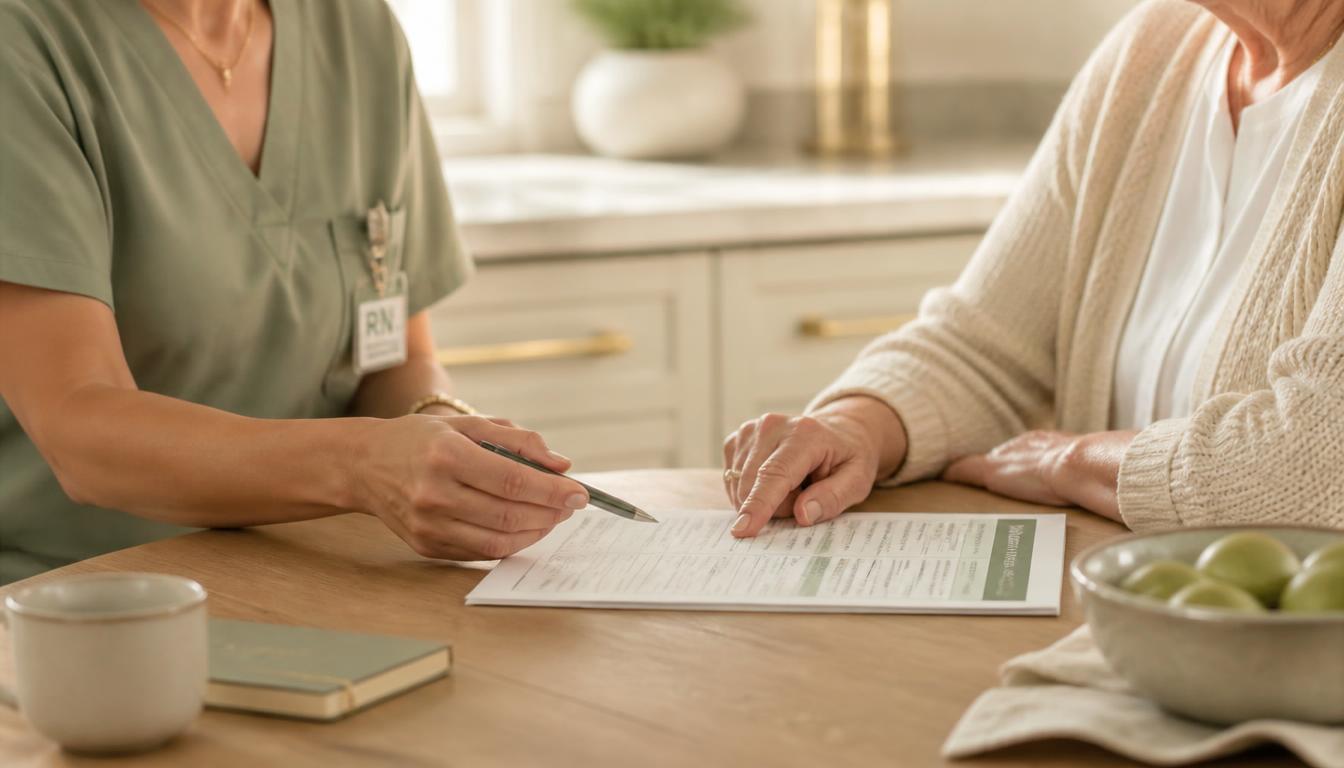
Coordinate skilled nursing care at home.
Speak with our team about private duty nursing for your situation. We will assess clinical needs and structure a care plan that works for your home and your family.
Researched. Factual. From the field.
Direct answers grounded in current healthcare practice and research.
What is the difference between private duty nursing and home health?
Home health is a Medicare-defined benefit, typically physician-ordered, short-term, and structured around specific recovery goals. Private duty nursing is private-pay, ongoing, flexible, and structured around continuous client need rather than insurance authorization. Many families layer private duty nursing on top of home health to add the continuity insurance does not cover.
Do you provide 24-hour care?
Yes. Engagements range from a few hours per day for medication oversight and wound checks to 24-hour shifted nursing for clients with complex needs. Staffing is built around what the client actually requires.
What is the difference between an RN and an LVN in private duty nursing?
Registered Nurses (RNs) are trained for the broadest scope of clinical assessment, care planning, and complex medication management. Licensed Vocational Nurses (LVNs) work under the direction of an RN and handle routine clinical tasks, wound care, medication administration, and observation. WHC coordinates the right level based on the clinical scenario.
How is private duty nursing billed?
Services are billed privately, typically hourly. Specific rates depend on the level of nursing required (RN versus LVN), shift length, and any specialty services included. Some long-term care insurance policies reimburse for private duty nursing when criteria are met.
Can you start private duty nursing right after a hospital discharge?
Yes. Hospital discharge is one of the most common entry points. We can coordinate skilled nursing to begin the same day or next day to ensure recovery is supported during the highest-risk first week post-discharge.
Is a private duty nurse the same as a home nurse or an in-home nurse?
Yes, in everyday use those all describe the same thing: a nurse who comes to where the client lives. “Home nurse” and “in-home nurse” are informal names families use; “private duty nurse” is the industry term for one-to-one nursing paid for privately rather than through an agency benefit. The labels that genuinely mean something different are home health, which is a Medicare-certified benefit with strict eligibility rules, and caregiving, which is non-clinical support and cannot include nursing tasks.
Is a private duty nurse the same as a private caregiver?
No. A private duty nurse holds an active nursing license, RN or LVN, and does clinical work: wound and drain care, IV medication, catheter and feeding tube care, and assessment of a condition that can change quickly. A private caregiver provides non-medical help such as bathing, meals, transportation, and companionship, and cannot perform clinical tasks. WholeHealth Concierge places and supervises licensed nurses and does not provide caregivers, though it will coordinate with a caregiver a family already has. If the need is mostly personal care rather than clinical care, we will tell you that.
How do I hire a home nurse in Orange County?
Start with a clinical assessment, because what the nurse needs to do determines the license required. WholeHealth Concierge begins with a consultation covering the diagnosis, the medication list, the home setup, and the hours the family actually needs, then matches a licensed RN or LVN to the case and supervises that nurse clinically. Meagan Williams, RN, BSN, CCRN, places and oversees the nurses, so families are not screening licenses on their own. Care often begins within a day or two, sooner when a hospital discharge sets the timeline.