
- Ask the discharge team three things first: what equipment is coming, what help with daily activities is needed, and whom to call.
- Put the bed, and a bathroom or commode, on the floor where your loved one will spend most of the day (MedlinePlus).
- The CDC says more than one out of four older people falls each year, and falling once doubles the chances of falling again. Light and clear the path from the bed to the bathroom.
- Keep every medicine in one well-lit spot with the new list beside it; do not take medicine in the dark (NIA).
- In California, an inpatient can name one family caregiver, and the hospital must notify that person of the discharge (Health and Safety Code section 1262.5).
In this article
- What should you do before the hospital sends your loved one home?
- Where should your loved one sleep for the first weeks?
- How do you lower fall risk before your loved one walks in the door?
- What does the bathroom need?
- Which supplies and equipment should be in the house on day one?
- How should you set up the medication spot?
- What should the first day at home look like?
- Who should stay the first night?
- What if the home is not ready on discharge day?
- How does WholeHealth Concierge help families get the home ready?
- Frequently asked questions
- Sources
What should you do before the hospital sends your loved one home?
Start at the hospital, not at home. Medicare.gov's discharge planning checklist, written for patients and caregivers leaving a hospital, nursing home or other care setting, tells families to ask whether the patient will need medical equipment (like a walker), whether Medicare covers it, and who will arrange its delivery. It asks whether the patient is ready for bathing, dressing, using the bathroom and climbing stairs. And it tells the caregiver to get prescriptions and run any other errands, such as food for a special diet, before the person is discharged, so there are no extra trips on the first day.
California adds a right many families do not know about. Under Health and Safety Code section 1262.5, a hospital must give each inpatient the chance to identify one family caregiver who may help after discharge, and record that person in the medical chart. The hospital's policy must have that caregiver notified of the discharge as soon as possible, and in any event when the attending physician issues the discharge order. The patient and the caregiver must also be told about care needs after discharge, including education about the patient's medications, with a chance for the caregiver to ask questions. If you are the one getting the house ready, ask the nurse to list you as the designated caregiver.
Ask, too, which activities your loved one can manage alone right now. MedlinePlus, the National Library of Medicine's consumer health service, says people coming home may need help with bathing, using the toilet, cooking, running errands, shopping, going to see the provider and exercising. Those answers decide how much of this guide you need. MedlinePlus says plainly that you may not need all of the changes it lists.
Three questions to ask the discharge team
- EquipmentWhat equipment will my loved one need at home, does Medicare cover it, and who arranges the delivery?
- Daily activitiesWhich of bathing, dressing, using the bathroom and climbing stairs will need help?
- Who to callWhom do we call with questions, and which complications should we watch for and what do we do about them?
Source: Medicare.gov, Your discharge planning checklist (CMS Product No. 11376, December 2025). California caregiver rights: Health and Safety Code section 1262.5.
Where should your loved one sleep for the first weeks?
On the floor where they will spend most of the day. MedlinePlus's guide to getting your home ready after the hospital says to set up the bed on the first floor, or the entry floor, if you can, and to have a bathroom or a portable commode on the same floor where your loved one will spend most of the day. In many Orange County and Los Angeles homes, that means turning a ground-floor den, office or guest room into the bedroom for a few weeks, so the stairs are not part of every trip.
Then set up the bedside so nothing requires a walk in the dark. MedlinePlus suggests making sure everything your loved one needs can be reached without getting on tiptoes or bending down, and placing a chair with a firm back in the kitchen, bedroom, bathroom and other rooms they will use, so they can sit for daily tasks. If your loved one will use a walker, it suggests attaching a small basket to hold a phone, a notepad and a pen.
Five things within reach of the bed
Sources: CDC STEADI, Check for Safety; National Institute on Aging, Preventing Falls at Home: Room by Room; MedlinePlus, Getting your home ready.
Whether a hospital bed belongs in that room is a question for the discharge team. MedlinePlus's guide to your discharge plan lists a hospital bed among the special equipment to ask your nurse or discharge planner about, and Medicare.gov lists hospital beds among the durable medical equipment Part B can cover when a doctor or other provider orders it for use in the home.
How do you lower fall risk before your loved one walks in the door?
Plan for falls, because they are common. The CDC's Facts About Older Adult Falls page says more than one out of four older people falls each year, but less than half tell their doctor, and that falling once doubles your chances of falling again. Its list of risk factors that can be changed includes home hazards such as broken or uneven steps, and throw rugs or clutter that can be tripped over. The CDC's brochure for family caregivers puts it in five words: most falls happen at home.
Why the walk through the house matters
Walk the house the way your loved one will walk it, starting at the car. The CDC's STEADI checklist, Check for Safety, goes room by room and pairs each hazard with a fix. The National Institute on Aging's room-by-room guide and Mayo Clinic's fall prevention tips cover the same ground. The main fixes, by room:
The fixes to make before discharge day
Sources: CDC STEADI, Check for Safety: A Home Fall Prevention Checklist for Older Adults (2017); National Institute on Aging, Preventing Falls at Home: Room by Room.
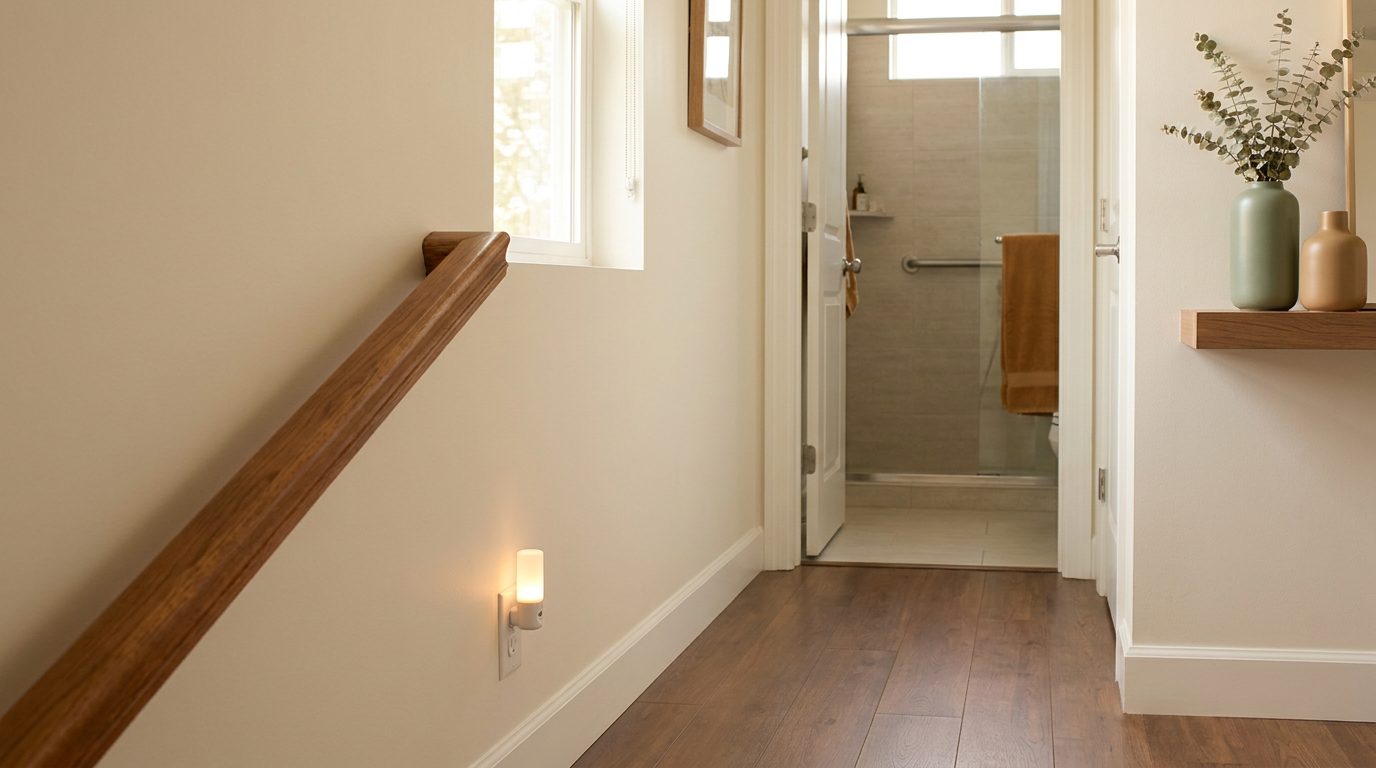
The path from the bed to the bathroom deserves the most attention, because it is the trip your loved one will make at night, tired, and possibly on new medicines. The CDC checklist asks one question about it: is the path from your bed to the bathroom dark? Its fix is a nightlight, and it notes that some go on by themselves after dark. MedlinePlus adds two rules for the first weeks: your loved one should not carry anything while walking, because they need their hands to help them balance, and consider having a small pet stay with a friend or in a kennel for the first few weeks, because pets that move around the walking path may cause a trip.
Footwear matters too. Mayo Clinic warns that high heels, floppy slippers, shoes with slick soles and walking in stocking feet can make you slip, and recommends properly fitting, sturdy, flat shoes with nonskid soles. Leave a pair by the bed. If your loved one fell before this hospital stay, the National Institute on Aging notes that a doctor might suggest an occupational therapist, physical therapist or nurse visit the home to assess its safety; ask the discharge team whether that applies. Our guide to what to do when a loved one falls at home covers the questions to ask before discharge after a fall.
What does the bathroom need?
Most of the equipment questions land here. MedlinePlus's bathroom setup guidance, point by point:
- Grab bars to help get in and out of the tub and to sit down and get up from the toilet, secured vertically or horizontally to the wall, not diagonally.
- No towel racks as grab bars. MedlinePlus says they cannot support a person's weight.
- Non-slip suction mats or rubber silicone decals in the tub, a non-skid bath mat outside it, and a dry floor outside the tub or shower.
- A bath or shower chair with non-skid rubber tips on the legs; if it goes in a bathtub, a seat without arms.
- A raised toilet seat, or a commode chair instead of a toilet.
- Soap and shampoo placed where your loved one does not need to stand up, reach or twist to get them.
Mayo Clinic adds a hand-held shower nozzle for bathing while sitting down. The National Institute on Aging suggests leaving a light on in the bathroom at night, or using a night light that turns on automatically in the dark. If the grab bars cannot go in before discharge day, tell the discharge team; a portable commode on the same floor, which MedlinePlus lists as an option, may cover the gap while the work is scheduled.

Which supplies and equipment should be in the house on day one?
Ask the nurse or discharge planner which of these your loved one needs. MedlinePlus's guide to your discharge plan lists the special equipment and supplies to ask about: a hospital bed, wheelchair, walker or cane, shower chair, portable toilet, oxygen supply, diapers, disposable gloves, bandages and dressing, and skin care items. Its home-ready guide adds smaller aids that make daily tasks easier: a long-handled shower sponge, a long-handled shoehorn, a reacher for picking things up from the floor, and a sock aid.
For the larger items, sort out who pays before anything is delivered. Medicare.gov says Part B covers medically necessary durable medical equipment if a doctor or other health care provider orders it for use in the home, and lists canes, commode chairs, crutches, hospital beds, oxygen equipment, walkers and wheelchairs among the covered items. Medicare only pays for equipment from suppliers enrolled in Medicare, so ask the supplier whether it participates in Medicare or will accept assignment of the claim first.
Then stock the kitchen and the cupboards. MedlinePlus suggests stocking up on canned or frozen food, toilet paper, shampoo and other personal items; buying or making single meals that can be frozen and reheated; putting food and other supplies in a cupboard between waist and shoulder level; and leaving glasses, silverware and other everyday items on the kitchen counter. If the discharge papers mention a special diet, shop for it before the day, as Medicare.gov's checklist suggests.
What to line up before the ride home
Sources: MedlinePlus, Leaving the hospital: your discharge plan and Getting your home ready; Medicare.gov, Durable medical equipment (DME) coverage and Your discharge planning checklist.
How should you set up the medication spot?
Pick one place for every medicine in the house, with good light, a flat surface and the written schedule beside it. The National Institute on Aging's guide to taking medicines safely as you age gives the reason for the light: do not take medicine in the dark, because you might make a mistake. It also notes that some people use meals or bedtime as reminders, so a spot your loved one passes at breakfast or before bed tends to fit the routine. Ask the pharmacist about special storage instructions, such as whether a medicine should be kept in the refrigerator, which the NIA recommends asking.
What goes in the spot:
- The written list. The NIA says it should include the name of each medicine or supplement, the amount and the time or times it is taken, and for prescriptions, the doctor who prescribed it and why. MedlinePlus says the discharge plan should list all medicines and how and when to take them, and tells patients to have the provider highlight any new medicines and any that need to be stopped or changed.
- A daily schedule. AHRQ's guide, Taking Care of Myself: A Guide for When I Leave the Hospital, lays out morning, afternoon, evening and bedtime medicines, with why each one is taken, how much and how.
- A reminder system. The NIA mentions charts, calendars, weekly pill boxes, timers and medication reminder apps.
- The pharmacy's number. The NIA suggests having all prescriptions filled at the same pharmacy where you can, so the records are in one place.
- A locked drawer for prescription pain medicines such as opioids, which the NIA says to keep in a locked cabinet or drawer, out of the reach of children and pets.
Old bottles are the hidden problem. The bottles at home still reflect the plan from before the hospital stay. Medicare.gov's checklist asks families to write down every prescription drug, over-the-counter drug, vitamin and herbal supplement taken at home, note any changes or additions during the stay, and review with the staff which ones to continue. Move the stopped ones out of the medication spot, and ask the pharmacist how to dispose of them; the NIA points to the FDA's guidance on disposing of unused medicines. Our free printable medication list is built for this step.

The medication spot, at a glance
- One place, good light, never in the dark.
- The new list beside it, with new, changed and stopped medicines marked.
- Stopped medicines out of the spot and asked about at the pharmacy.
- Prescription pain medicines in a locked drawer.
What should the first day at home look like?
Write the plan down before the day, because the day itself rarely runs to the clock. Discharge timing is hard to predict; our guide to how long hospital discharge takes explains why. A simple sequence, so everyone in the family knows their part:
One example of a first day home
- Before you leave the hospitalCollect the written discharge instructions, the medication list, and the names and phone numbers to call with questions. Pick up new prescriptions on the way home, or before, so there is no second trip.
- ArrivalPorch light on if it is dark, front steps clear, and the shortest route from the car to the bed or chair already open.
- Settling inPhone, water, glasses and the lamp within reach. Show your loved one the night light, the route to the bathroom or commode, and where the phone is.
- The first medicine timeCheck each dose against the new list, in good light. If something does not match, call the number on the discharge papers or the pharmacy before giving it.
- EveningLight the route to the bathroom, set the shoes by the bed, and agree who will hear your loved one if they need help in the night.
An illustration of how a family can organize the day, not a clinical plan; the discharge instructions set the real one. Sources: Medicare.gov, Your discharge planning checklist; AHRQ, Taking Care of Myself; National Institute on Aging, Room by Room and Taking Medicines Safely. In an emergency, call 911.
Keep the discharge folder in one place, next to the medication spot. AHRQ's guide tells patients to take it home, share it with family members and others who want to help, and bring it to all doctor appointments so the doctor knows how your loved one has been cared for since leaving the hospital. The Medicare.gov checklist adds one more item to write down before you leave: the complications to watch for, and what to do about them. If one of those happens, call the number on the papers. In an emergency, call 911.

Who should stay the first night?
Decide this before discharge day, not at bedtime. The first night is the first stretch with no hospital staff down the hall, and it is when an unfamiliar route, new medicines and a tired loved one all meet.
MedlinePlus says that if no one can help at home for the first 1 or 2 weeks after the hospital stay, ask the provider about having a trained caregiver come to the home, and adds that this person can also check the safety of the home and help with daily activities. Medicare.gov's checklist puts the question to the caregiver directly: make sure you can give the person you are caring for the help they need, decide which tasks you need help with and whether you need education or training, and talk to the staff about getting that help before discharge. It also tells families to ask the staff to show them how to do any task that requires special skills, like changing a bandage, and then to practice it.
Who covers the first night
- The person staying is rested and has read the written discharge instructions.
- The staff showed them any task that needs special skills, and they practiced it.
- Your loved one can reach the bathroom or commode with the help the discharge team described.
- Someone will hear your loved one during the night.
- Nobody can stay for the first 1 or 2 weeks.
- The caregiver is not sure they can give the help needed, or needs training first.
- The discharge team said your loved one needs help with the bathroom, stairs or getting up.
- The only person available also has to work the next day.
Sources: MedlinePlus, Getting your home ready; Medicare.gov, Your discharge planning checklist.
If family cannot cover the night, there are several kinds of overnight help, from an awake overnight shift to a live-in arrangement, and they are not the same service. Our page on overnight, 24-hour and live-in care sets them side by side, and our guide to how many hours of care a loved one needs helps size the first week.
What if the home is not ready on discharge day?
Say so, early, to the discharge planner or nurse. California's Health and Safety Code section 1262.5 requires every hospital to have a written discharge planning policy, and that policy must require appropriate arrangements for care after discharge, including care at home, for patients likely to suffer adverse health consequences without adequate discharge planning. Missing equipment, a bathroom on the wrong floor or no one to stay the first night are worth raising inside that process, before the discharge order, not after.
For a Medicare patient who feels the discharge is coming too soon, Medicare.gov's checklist explains the fast appeal: in a hospital, the staff should give a notice called the Important Message from Medicare, which contains information about fast appeal rights. Our guide to whether a hospital can discharge you before you're ready walks through it, and our printable hospital discharge checklist covers the papers to collect before you leave.
How does WholeHealth Concierge help families get the home ready?
WholeHealth Concierge is a private-pay care management practice serving families across Orange County, Los Angeles and the Inland Empire. Getting a home ready is planning and coordination work, and that is where we help. Before discharge, we help families put the questions in this guide to the hospital's discharge team, make sure the answers are written down, and turn them into a plan for the house: what equipment is coming and who is delivering it, what needs to be bought, where the medication spot goes and who stays the first night.
We coordinate with the people involved, from the discharge planner to the equipment supplier and the family members taking turns, and we advocate for your loved one if the plan does not feel safe before they leave. Every plan starts with a free 15-minute phone consultation, where we listen to what is happening and talk through the next steps. Read more about our hospital discharge planning and care management, or call (213) 298-3288.
From the first call to the first night
- ListenA free 15-minute phone consultation about your loved one, the hospital stay and the home.
- PlanThe questions for the discharge team, and a written plan for the house, the first day and the first night.
- CoordinateThe discharge planner, the equipment supplier and the family members taking turns.
- AdvocateSpeaking up for your loved one if the plan does not feel safe before they leave.
Frequently asked questions
How do I prepare my home for an older loved one coming home from the hospital?
Ask the discharge team what equipment and help your loved one will need. Then set up a bedroom and a bathroom or commode on the entry floor, clear and light the path between them, add grab bars and a shower chair, stock food and supplies, make one well-lit medication spot, and decide who stays the first night. MedlinePlus, the CDC and the National Institute on Aging all publish checklists for these steps.
Should my loved one sleep downstairs after a hospital stay?
If stairs are hard right now, it usually makes sense. MedlinePlus recommends setting up the bed on the first floor, or the entry floor, if you can, with a bathroom or a portable commode on the same floor where your loved one will spend most of the day.
Where should grab bars go in the bathroom?
MedlinePlus recommends grab bars to help get in and out of the tub and to sit down and get up from the toilet, secured vertically or horizontally to the wall, not diagonally. The CDC checklist says next to and inside the tub, and next to the toilet. Never use a towel rack as a grab bar; MedlinePlus says towel racks cannot support a person's weight.
What equipment might my loved one need at home after the hospital?
Ask the nurse or discharge planner. MedlinePlus lists items to ask about, including a hospital bed, wheelchair, walker or cane, shower chair, portable toilet, oxygen supply, disposable gloves and bandages. Medicare.gov says Part B covers medically necessary durable medical equipment that a doctor or other provider orders for use in the home, from suppliers enrolled in Medicare.
How should I organize my loved one's medications at home?
Keep every medicine in one well-lit spot with a written list of each medicine, the amount and the times. Mark which ones are new, changed or stopped after the hospital stay, and set the stopped ones aside. The National Institute on Aging mentions charts, calendars, weekly pill boxes and phone reminders, and says not to take medicine in the dark.
Does someone need to stay with my loved one the first night home?
Plan for it before discharge day. MedlinePlus says that if no one can help at home for the first 1 or 2 weeks after a hospital stay, ask the provider about having a trained caregiver come to the home. Medicare.gov's checklist asks caregivers to make sure they can give the help needed and to talk to the staff about getting help before discharge.
What are the most common fall hazards in a home?
The CDC lists home hazards such as broken or uneven steps and throw rugs or clutter that can be tripped over. Its Check for Safety checklist also points to cords across walkways, missing or loose handrails, stairs without a light at the top and bottom, a dark path from the bed to the bathroom, and slippery tub or shower floors.
Can I be my loved one's designated caregiver at a California hospital?
Yes. Under California Health and Safety Code section 1262.5, a hospital must give each inpatient the chance to identify one family caregiver, record that person in the medical chart, notify them of the discharge, and give them information and, when appropriate, instruction about care after discharge, including the patient's medications.
How can WholeHealth Concierge help before my loved one comes home?
WholeHealth Concierge helps families in Orange County, Los Angeles and the Inland Empire plan and coordinate the move home: putting the right questions to the discharge team, lining up equipment and supplies, planning the first day and night, and advocating for your loved one if the plan does not feel safe. It starts with a free 15-minute phone consultation at (213) 298-3288.
Sources
Statements on this page come from the public sources below, each opened and checked on the date shown. This page is general information for families; your loved one's discharge instructions and their doctors' advice come first. WholeHealth Concierge provides care coordination, planning and advocacy; diagnosis and prescribing stay with your loved one's physicians and other licensed prescribers.
- Centers for Disease Control and Prevention, "Facts About Older Adult Falls," Sept. 8, 2026. cdc.gov. Accessed October 13, 2026.
- CDC STEADI, "Check for Safety: A Home Fall Prevention Checklist for Older Adults," 2017. cdc.gov (PDF). Accessed October 13, 2026.
- CDC STEADI, "Family Caregivers: Protect Your Loved Ones from Falling," 2018. cdc.gov (PDF). Accessed October 13, 2026.
- National Institute on Aging, "Preventing Falls at Home: Room by Room," content reviewed September 12, 2022. nia.nih.gov. Accessed October 13, 2026.
- National Institute on Aging, "Taking Medicines Safely as You Age," content reviewed September 22, 2022. nia.nih.gov. Accessed October 13, 2026.
- Agency for Healthcare Research and Quality, "Taking Care of Myself: A Guide for When I Leave the Hospital," content last reviewed November 2020. ahrq.gov. Accessed October 13, 2026.
- Centers for Medicare & Medicaid Services, "Your discharge planning checklist," CMS Product No. 11376, December 2025. medicare.gov (PDF). Accessed October 13, 2026.
- Medicare.gov, "Durable medical equipment (DME) coverage." medicare.gov. Accessed October 13, 2026.
- MedlinePlus (U.S. National Library of Medicine), "Getting your home ready: after the hospital," reviewed July 3, 2025. medlineplus.gov. Accessed October 13, 2026.
- MedlinePlus, "Leaving the hospital: your discharge plan," reviewed July 15, 2024. medlineplus.gov. Accessed October 13, 2026.
- Mayo Clinic Staff, "Fall prevention: Simple tips to prevent falls," July 19, 2026 (WholeHealth Concierge is not affiliated with Mayo Clinic). mayoclinic.org. Accessed October 13, 2026.
- California Health and Safety Code section 1262.5 (hospital discharge planning and family caregivers). leginfo.legislature.ca.gov. Accessed October 13, 2026.